Kling 4.0 vs Seedance 2.5 vs MiniMax H3 Max: Video API Guide
Compare Kling 4.0, Seedance 2.5, and MiniMax H3 Max video APIs on TokLab: 10-second clip budgets, native audio, keyframes, retry math, and Python code.
Read as MarkdownA single 10-second AI video clip looks cheap on a marketing slide, right up until you run a real creative pipeline with three takes per shot, reference footage attached, and 100 deliverables due before a campaign launch. In late November 2026, three model families dominate commercial video API traffic on TokLab: Kuaishou's Kling 4.0, ByteDance's Seedance 2.5, and MiniMax's H3 Max. Their live rates span more than a six-to-one range per second of output.
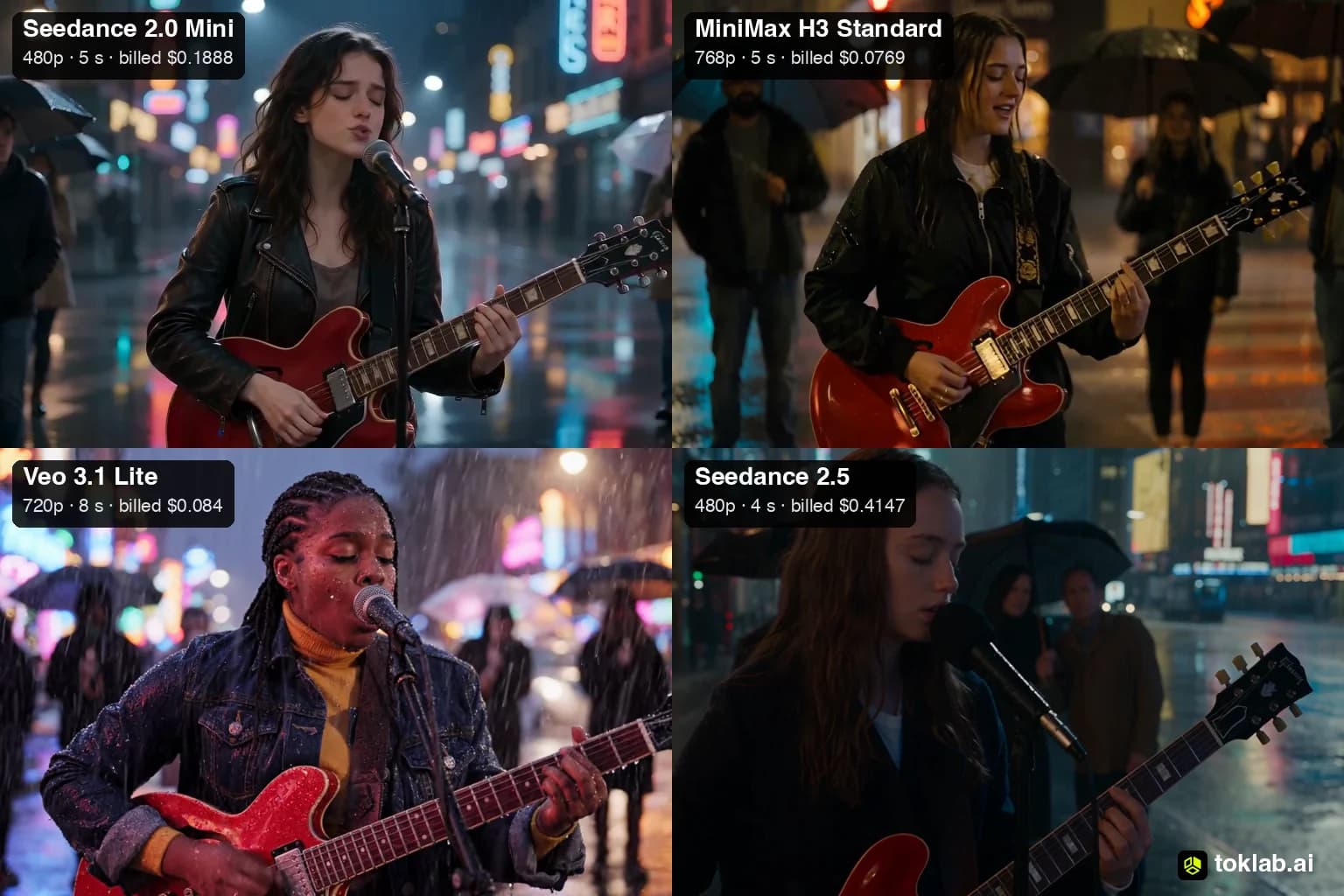
At the budget end, minimax-h3-max-turbo bills $0.02285/s, minimax-h3-max bills $0.04570/s, and minimax-h3 (Pro) bills $0.073125/s. In the mid-to-flagship tier, kling-4-0-flash starts at $0.085/s, dreamina-seedance-2-5-flash starts at $0.12/s, kling-4-0 starts at $0.1425/s, and full dreamina-seedance-2-5 bills by video tokens ($6.38 per million output tokens in reference-video mode, scaling by pixel grid and frame count).
Choosing the right model comes down to usable takes per dollar, not the lowest per-second sticker. A model that costs twice as much per second but hits your exact camera move on Take 1 beats a cheap model that burns four takes to get usable motion. This guide breaks down all seven model IDs on TokLab's live pricing page, calculates 10-second clip and retry budgets, compares native audio and keyframe steering, and provides a unified /v1/videos/generations worker.
Lineup and live TokLab rate structure
All seven tiers share one asynchronous submission contract on TokLab (POST https://api.toklab.ai/v1/videos/generations followed by GET /v1/tasks/{id}), and failed API tasks carry a $0 charge. What differs across the lineup is resolution ceiling, maximum clip duration, reference capacity, and whether billing is flat per second or calculated from video tokens.
| Model ID | Family & tier | Live TokLab rate | Resolutions | Clip length | Reference & control modes |
|---|---|---|---|---|---|
minimax-h3-max-turbo | MiniMax H3 Turbo | $0.02285 / s | 480P, 768P | 5–15 s | Text, first/last frame, image/video/audio refs |
minimax-h3-max | MiniMax H3 Max | $0.04570 / s | 480P, 768P | 5–15 s | Text, first/last frame, image/video/audio refs |
minimax-h3 | MiniMax H3 Pro | $0.073125 / s | 768P, 1080P | 5–10 s | High-fidelity Pro tier, native sound |
kling-4-0-flash | Kling 4.0 Flash | from $0.085 / s | 720p, 1080p | 3–30 s | Fast Kling 4.0 tier with stereo sound |
kling-4-0 | Kling 4.0 Flagship | from $0.1425 / s | 720p, 1080p | 3–30 s | 5 modes: text, up to 10 keyframes, refs, edit, extend |
dreamina-seedance-2-5-flash | Seedance 2.5 Flash | from $0.12 / s | 480p, 720p | 4–30 s | Text, first/last frame, up to 10 img, 5 vid, 5 audio |
dreamina-seedance-2-5 | Seedance 2.5 Flagship | $6.38 / 1M tokens (ref-video tier; token-billed) | 480p, 720p, 1080p | 4–30 s (or auto) | Up to 30 img, 10 vid, 10 audio refs + draft upgrade |
Two architectural nuances shape how teams actually use these seven tiers. First, minimax-h3-max and minimax-h3-max-turbo top out at 768P and 15 seconds, which is plenty for vertical social ads, pre-visualization, and B-roll, though below broadcast 1080p deliverables. Second, both Kling 4.0 and Seedance 2.5 stretch up to 30 seconds in a single pass, eliminating awkward 5-second jump cuts for narrative scenes, product walkthroughs, and continuous dolly shots.
10-second clip budgets and the reference-video multiplier
To compare billing mechanics fairly, let us price a standard 10-second, 16:9 clip across all seven models using TokLab's live base rates. For token-billed dreamina-seedance-2-5, ByteDance's verified formula is (input_video_seconds + output_seconds) × width × height × 24 ÷ 1,024. At 720p (1280×720), one second equals exactly 21,600 video tokens (216,000 tokens for 10 seconds); at 480p (854×480), one second is roughly 9,608 tokens.
| Model ID | 10-second base clip cost | 10-second clip + 10s reference video | Cost vs minimax-h3-max-turbo (base) |
|---|---|---|---|
minimax-h3-max-turbo | $0.2285 | Flat per-second output tier | 1.0x |
minimax-h3-max | $0.4570 | Flat per-second output tier | 2.0x |
minimax-h3 | $0.7313 | Flat per-second output tier | 3.2x |
kling-4-0-flash | from $0.8500 | Scales by resolution/mode | 3.7x |
dreamina-seedance-2-5-flash | from $1.2000 | Bills uploaded + generated seconds | 5.3x |
kling-4-0 | from $1.4250 | Scales by resolution/mode | 6.2x |
dreamina-seedance-2-5 (720p ref-video token rate) | $1.3781 (at $6.38/1M, 216K tok) | $2.7562 (20s billed = 432K tok at $6.38/1M) | 6.0x (12.1x w/ 10s ref) |
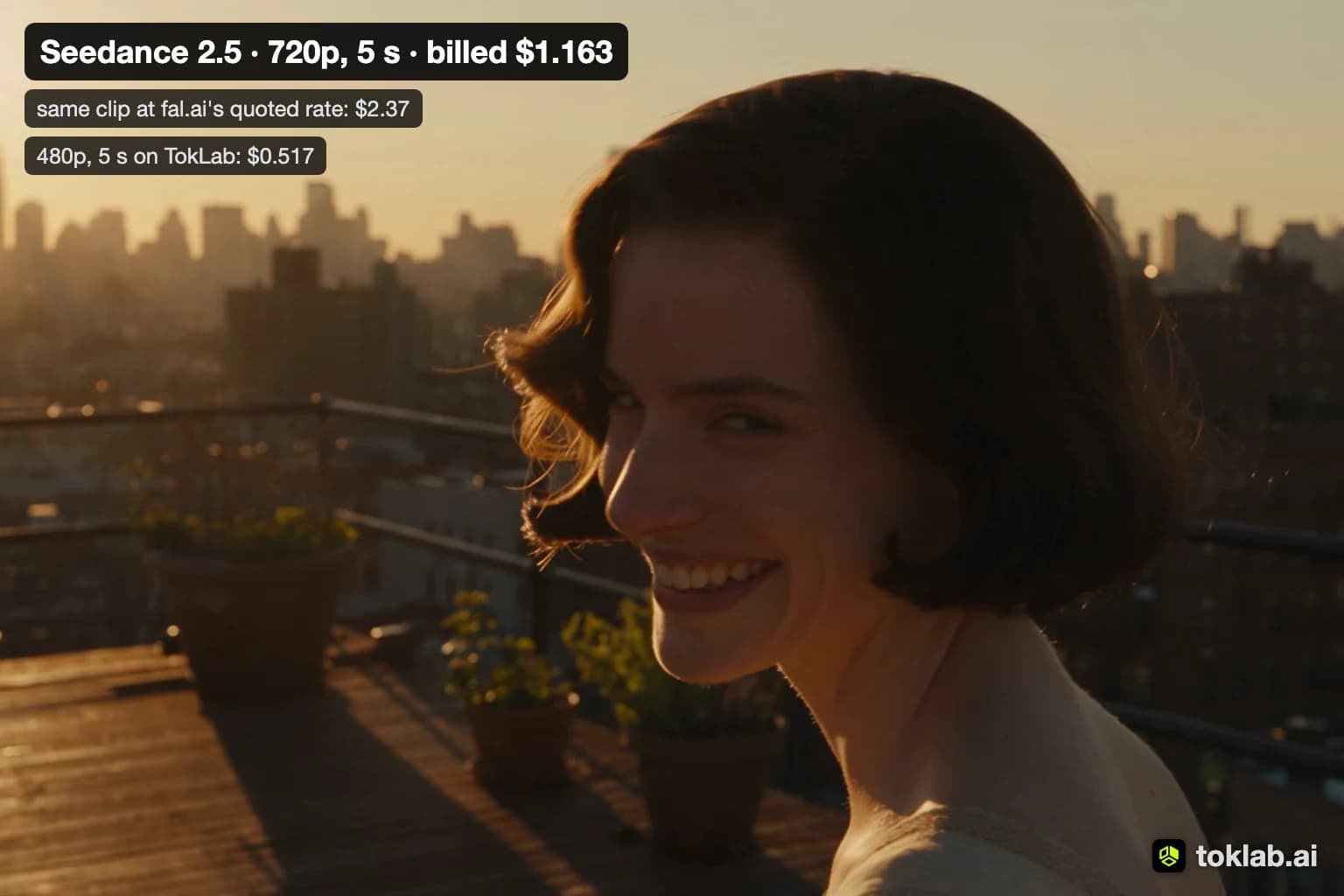
Look closely at that last row, because it is the single most common budgeting surprise in Seedance 2.5 deployments. When you attach a reference video to dreamina-seedance-2-5, the per-million token rate drops to $6.38 / 1M (about $0.1378 per billed second at 720p, versus ~$0.2307/s on the no-reference standard rate), but the uploaded reference duration is added to the billable seconds. Generating a 10-second 720p output guided by a 10-second reference video bills 20 seconds total (432,000 tokens × $6.38/1M = $2.7562). By contrast, reference images and reference audio clips on Seedance 2.5 add zero billable seconds, so anchoring character identity with still frames instead of long reference clips cuts your Seedance bill in half immediately.
Native audio, dialogue, and lip-sync trade-offs
All three families generate synchronized audio alongside video in a single pass, which removes the manual Foley and ambient-bed step for rough cuts, though each family handles speech and sound mix differently in production.
- Kling 4.0 and Kling 4.0 Flash generate native stereo sound across every mode (text-to-video, keyframe, reference, edit, and extend). Stereo separation and environmental Foley (rain on pavement, footsteps, room tone, crowd murmur) arrive balanced enough for social edits without heavy post-mixing. When prompts include short spoken lines, lip-sync holds cleanly on close-up and medium shots up to 1080p.
- Seedance 2.5 and Seedance 2.5 Flash support both prompt-driven native audio (
generate_audio: true) and explicit audio references (up to 10 clips on standard Seedance 2.5, up to 5 clips on Flash, each 2–30 seconds). Note two operational caveats from real renders: first, reference audio cannot be combined with first-and-last-frame constraints in the same request; second, default ambient audio tracks on Seedance 2.5 can occasionally come back quiet (around −35 dBFS in low-key scenes), so production pipelines should run an automated loudness normalization pass (ffmpeg loudnorm) before publishing. - MiniMax H3 Max and Turbo bundle dialogue, ambience, and sound effects directly into every 5-to-15-second clip at no extra audio surcharge. For talking-head explainers, product demos, and rapid localization tests where budget per clip must stay under fifty cents, MiniMax H3 Max delivers the highest audio-visual completeness per dollar.
Keyframe steering, camera choreography, and clip length ceilings
When creative directors complain that AI video "feels random," the culprit is usually relying on text-only prompts instead of structural anchors. Here is how each family lets you lock composition and camera movement:
- Kling 4.0 leads on multi-keyframe choreography and post-generation editing. One
kling-4-0model ID covers five distinct modes: text-to-video, image-to-video with up to 10 keyframes, multi-modal reference generation (images, videos, audio), video editing, and video extension. If your storyboard specifies exact visual beats at second 0, second 4, second 9, and second 15 (for example, a product reveal transitioning from macro texture to wide tabletop), supplying still keyframes generated via Kling Image 4.0 orseedream-5-5removes camera drift completely. - Seedance 2.5 leads on filmic framing and deep reference libraries. Accepting up to 30 images, 10 videos, and 10 audio clips on the flagship tier (10/5/5 on
dreamina-seedance-2-5-flash), Seedance 2.5 excels at continuous 15-to-30-second single-shot camera pushes with natural lens bokeh and believable human motion. Its 480p draft workflow also lets teams test motion timing cheaply before promoting winning seeds to 720p or 1080p. - MiniMax H3 Max leads on fast first-and-last-frame transitions. Supporting 5-to-15-second clips at
480Por768Pwith first/last frame pinning and image/video/audio references,minimax-h3-maxandminimax-h3-max-turboturn around high-volume social cuts quickly enough to power real-time creative testing loops.
Failure-retry budgeting: what 100 finished clips actually cost
The biggest gap between a spreadsheet estimate and a real monthly invoice is creative rejection rate. On TokLab, technical failures (upstream timeouts, moderation blocks, HTTP 400 validation errors) bill $0. Creative retries (clips that render cleanly with HTTP 200 but have a warped hand, wrong camera pan, or awkward lip-sync) bill in full.
Let us model 100 approved 10-second clips under realistic take-rates: an exploratory text-only pipeline averaging 2.5 takes per approved clip (250 renders) versus a keyframe-anchored two-stage pipeline that tests motion on minimax-h3-max-turbo (2.0 takes) and renders final masters on a flagship tier (1.25 takes).
| Pipeline strategy (100 approved 10s clips) | Renders billed | Total spend | Effective cost per approved clip |
|---|---|---|---|
Pure minimax-h3-max-turbo (2.5 takes) | 250 × $0.2285 | $57.13 | $0.57 |
Pure minimax-h3-max (2.2 takes) | 220 × $0.4570 | $100.54 | $1.01 |
Pure kling-4-0-flash (2.0 takes) | 200 × $0.8500 | $170.00 | $1.70 |
Pure kling-4-0 text-only (2.2 takes) | 220 × $1.4250 | $313.50 | $3.14 |
Two-stage hybrid: 200 Turbo drafts + 125 kling-4-0 masters | 200 × $0.2285 + 125 × $1.4250 | $223.83 | $2.24 (-28.6%) |
Two-stage hybrid: 200 Turbo drafts + 125 seedance-2-5-flash masters | 200 × $0.2285 + 125 × $1.2000 | $195.70 | $1.96 |
Adding a keyframe-generation step first with GPT Image 2.6 or Kling Image 4.0 to lock frame 1 before calling the video API typically drops video take-rates from 2.5 down to 1.2–1.4, paying for the still image twenty times over.
Unified async worker on TokLab /v1/videos/generations
Because every video model on TokLab submits to POST https://api.toklab.ai/v1/videos/generations and polls GET /v1/tasks/{id}, one worker class can dispatch drafts to minimax-h3-max-turbo and final renders to kling-4-0-flash or dreamina-seedance-2-5-flash using one TOKLAB_API_KEY. Note that each vendor keeps its native payload fields (content array for MiniMax and Seedance; flat prompt and aspect_ratio for Kling).
import os
import time
import requests

API_KEY = os.environ["TOKLAB_API_KEY"]
HEADERS = {
    "Authorization": f"Bearer {API_KEY}",
    "Content-Type": "application/json",
}

def build_video_payload(tier: str, prompt: str, duration: int = 10) -> dict:
    if tier == "draft":
        return {
            "model": "minimax-h3-max-turbo",
            "content": [{"type": "text", "text": prompt}],
            "resolution": "768P",
            "duration": duration,
            "ratio": "16:9",
        }
    if tier == "seedance_flash":
        return {
            "model": "dreamina-seedance-2-5-flash",
            "content": [{"type": "text", "text": prompt}],
            "resolution": "720p",
            "duration": duration,
            "ratio": "16:9",
            "generate_audio": True,
        }
    return {
        "model": "kling-4-0-flash",
        "prompt": prompt,
        "resolution": "720p",
        "duration": duration,
        "aspect_ratio": "16:9",
    }

def generate_clip(tier: str, prompt: str, duration: int = 10) -> str:
    payload = build_video_payload(tier, prompt, duration)
    resp = requests.post(
        "https://api.toklab.ai/v1/videos/generations",
        headers=HEADERS,
        json=payload,
        timeout=60,
    )
    resp.raise_for_status()
    task_id = resp.json()["id"]

    # Persist task_id in your DB before polling to avoid duplicate billing on restart
    while True:
        poll = requests.get(
            f"https://api.toklab.ai/v1/tasks/{task_id}",
            headers={"Authorization": f"Bearer {API_KEY}"},
            timeout=30,
        )
        poll.raise_for_status()
        body = poll.json()
        status = body.get("status")
        if status == "completed":
            return body["output"]["video_url"]
        if status == "failed":
            raise RuntimeError(f"Video task {task_id} failed: {body}")
        time.sleep(5)

if __name__ == "__main__":
    draft_url = generate_clip(
        "draft",
        "Slow tracking shot along a wet neon street at dusk, light rain, warm reflections, natural rain ambience.",
        duration=10,
    )
    print("Draft clip URL:", draft_url)
Keep polling intervals between 5 and 10 seconds, enforce a job-level timeout of at least 10 minutes for 15-to-30-second 1080p renders, and never treat a client-side HTTP timeout during polling as a reason to resubmit POST /v1/videos/generations.
Production gotchas: aspect ratios, audio mixing, and storage lifecycle
Teams moving from manual playground tests to an automated video queue usually run into four operational edge cases that never appear in a vendor quickstart:
- Aspect ratio changes your Seedance 2.5 invoice, not your MiniMax invoice. Because
dreamina-seedance-2-5bills video tokens proportional towidth × height × 24 ÷ 1,024, switching from16:9(1280×720) to a square1:1or4:3social frame at the same height reduces total pixels per second and lowers the billed token count automatically. On flat per-second models such asminimax-h3-max,minimax-h3-max-turbo, andkling-4-0, changing aspect ratio keeps the per-second rate constant within the same resolution tier. - Keep spoken dialogue compact per 5-second beat. Across all three model families, cramming 30 words of voiceover into a 5-second shot causes rushed articulation, clipped consonants, and visible jaw desynchronization. Budgeting roughly 10 to 14 spoken words per 5 seconds yields far cleaner lip-sync and leaves natural breathing room for ambient sound. On
dreamina-seedance-2-5, also remember that reference audio clips cannot be paired with first-and-last-frame locks in the same request; choose either audio-driven pacing or strict start/end keyframe interpolation per shot. - Normalize audio loudness automatically after download. Because native audio loudness varies across prompts (especially on quiet moody scenes in Seedance 2.5 where default mixes can land near −35 dBFS), pipe every completed MP4 through an automated
ffmpegloudnormpass targeting −14 LUFS for social feeds or −16 LUFS for web embeds before handing clips to an editor or publishing pipeline. - Mirror outputs immediately and separate moderation failures from creative retries. Provider-hosted video URLs are temporary delivery links, not permanent CDN storage. As soon as
GET /v1/tasks/{id}returnscompleted, stream the MP4 directly into your own R2 or S3 bucket and record the exact duration, resolution, and model ID alongside the asset metadata. Trackfailedtasks separately from human-rejected takes in your telemetry: technical and moderation failures cost $0 on TokLab, whereas creative rejections drive your real cost per finished deliverable.
Choosing the right tier for your video stack
Match your model choice to the bottleneck that actually constrains your team:
- Pick
minimax-h3-max-turbo($0.02285/s) orminimax-h3-max($0.04570/s) for high-volume vertical ads, rapid storyboard pre-vis, and budget-capped SaaS video features where 768P and 5–15 seconds cover the product requirement. Upgrade tominimax-h3($0.073125/s) when you need MiniMax's Pro quality tier. - Pick
kling-4-0(from $0.1425/s) orkling-4-0-flash(from $0.085/s) when camera control, multi-keyframe precision (up to 10 frames), stereo sound, or in-place video editing and extension matter most. - Pick
dreamina-seedance-2-5($6.38/1M ref-video token rate) ordreamina-seedance-2-5-flash(from $0.12/s) for cinematic 15-to-30-second single-shot storytelling and heavy multi-modal reference packs, while budgeting uploaded reference video seconds explicitly in your forecast.
Sources
- TokLab Live Pricing — Verified TokLab rates for
kling-4-0,kling-4-0-flash,dreamina-seedance-2-5,dreamina-seedance-2-5-flash,minimax-h3-max,minimax-h3-max-turbo, andminimax-h3, checked November 23, 2026. - TokLab Model Catalog — Unified
/v1/videos/generationsgateway documentation and async task polling schema. - Seedance 2.5 Pricing Breakdown — Video-token formula verification and reference-video billing mechanics.
- Best AI Video Generators Tested Side by Side — Audio loudness observations and prompt-adherence testing across video models.