Seedream 5.5 vs GPT Image 2.6 vs Kling Image 4.0: API Guide
Compare Seedream 5.5 ($0.017), GPT Image 2.6 (token-billed), and Kling Image 4.0 ($0.057 2K) on TokLab across 1,000-image budgets, text, and multi-ref control.
Read as MarkdownIn late November 2026, building a production image pipeline means choosing among three flagship APIs that do not even bill in the same unit. ByteDance's seedream-5-5 (launched November 9, 2026) charges a flat $0.017 per image on TokLab, with its sibling seedream-5-0-pro at $0.03375 per image. OpenAI's GPT Image 2.6 (gpt-image-2.6-flare and gpt-image-2.6-sunburst, launched November 4, 2026) bills by output and input tokens—translating to OpenAI list costs of $0.0247 at low quality and $0.0527 at high quality for a 1024×1024 frame. Kuaishou's Kling Image 4.0 (launched November 17, 2026) bills per output resolution ($0.05714 at 2K or $0.08571 at 4K) plus $0.00286 per input reference image once per request.
Those pricing mechanics reflect three distinct engineering priorities. Seedream 5.5 is built for high-volume ecommerce catalogs, iterative multi-round editing, transparent PNGs, and layer decomposition. GPT Image 2.6 optimizes semantic instruction following and dense prompt reasoning at token-scaled quality tiers. Kling Image 4.0 targets high-resolution 2K/4K commercial photography, strict multi-reference compositing, and coherent 2-to-10-frame visual series—alongside its dedicated sibling Kling Image 4.0 Long Image for tall scrolling product detail pages and full webpage designs.
This studio audit compares all three models on verified TokLab pricing, 1,000-image monthly budgets, typography accuracy, reference-image workflows, and unified /v1/images/generations code.
Three billing models on one table
Before modeling monthly spend, it helps to line up the hard capabilities and billing formulas side by side. Every model below is accessible through TokLab's model catalog under one TOKLAB_API_KEY.
| Dimension | Seedream 5.5 (seedream-5-5) | GPT Image 2.6 (flare / sunburst) | Kling Image 4.0 (kling-image-4-0) |
|---|---|---|---|
| Release date | November 9, 2026 | November 4, 2026 | November 17, 2026 |
| Billing model | Flat per image | Output + input image/text tokens | Per output resolution + per reference image |
| Verified rate | $0.017 / image (seedream-5-0-pro: $0.03375) | OpenAI list: $0.0247 low / $0.0435 med / $0.0527 high (1024×1024) | $0.05714 (2K) / $0.08571 (4K) + $0.00286 / ref |
| Output resolution | 1K, 1.5K, 2K, or custom WIDTHxHEIGHT | Up to 3,840 px edge (8.29M px max) | Native 2k and 4k via API |
| Reference inputs | 0–10 reference images | Multi-image editing via token-billed image input | 0–10 refer_image items bound via @id tags |
| Connected series | Single image or 2–100 layer decomposition | Single-turn / multi-turn independent renders | Native series mode (2–10 coherent frames) |
| Transparent output | Native transparent PNG + layer split | Supported via transparent background option | Opaque raster outputs |
| Batch API discount | N/A (already flat $0.017) | Not supported on 2.6 (use GPT Image 2.5 for 50% Batch) | N/A (failed tasks cost $0) |
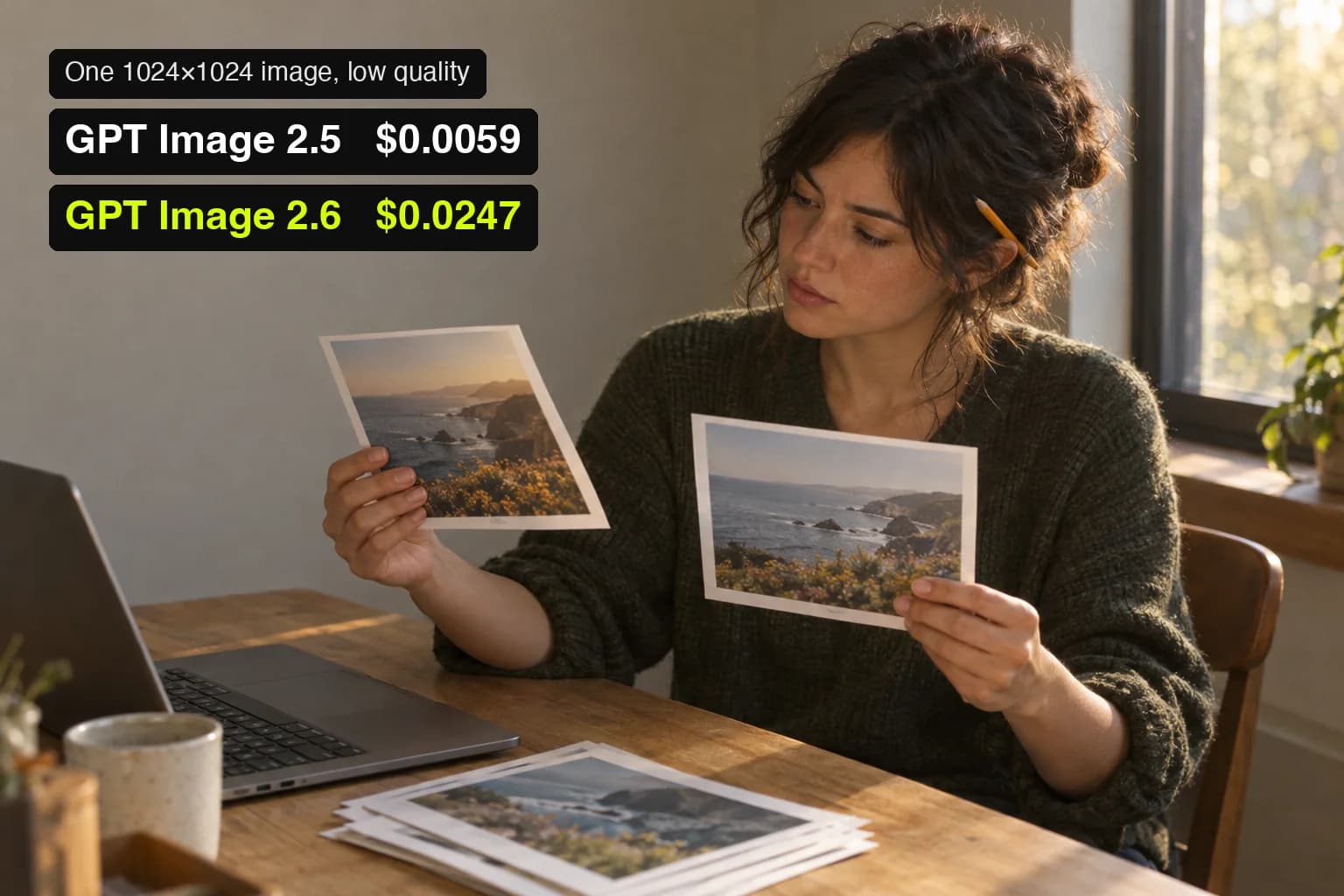
Two subtle pricing traps stand out in that table. First, on GPT Image 2.6, OpenAI kept the exact same per-token rate card as GPT Image 2.5 ($30/1M image output tokens, $8/1M image input, $5/1M text input), but multiplied the output token count by 4.2x at low quality and 3.3x at medium quality. As a result, a 1024×1024 low-quality image jumped from $0.0059 on 2.5 to $0.0247 on 2.6, which is more expensive than a full-resolution seedream-5-5 render at $0.017. Second, on Kling Image 4.0, reference images bill from the very first photo, but only once per request, not per output frame. Requesting a 6-shot 2K series with 3 reference images charges 6 outputs plus 3 references, never 18 references.
1,000-image monthly budget audit across four creative workflows
Per-image stickers rarely show how a pipeline behaves across a full month. The table below calculates exact monthly spend for 1,000 finished images across four common production scenarios, comparing seedream-5-5, seedream-5-0-pro, GPT Image 2.6 (OpenAI list math), and Kling Image 4.0.
| 1,000-image monthly workflow | Seedream 5.5 | Seedream 5.0 Pro | GPT Image 2.6 (list) | Kling Image 4.0 |
|---|---|---|---|---|
| 1. High-volume thumbnails / drafts (1K, 0 refs) | $17.00 | $33.75 | $24.70 (1024² low) | $57.14 (2K min) |
| 2. Marketing cards & ad creatives (1024²–2K, 0 refs) | $17.00 | $33.75 | $52.70 (1024² high) | $57.14 (2K) |
| 3. 4-angle product lookbooks (250 batches × 4 frames, 2 refs/batch) | $17.00 | $33.75 | $54.00+ (high + input tokens) | $58.57 (2K) / $87.14 (4K) |
| 4. Print & flagship 4K hero stills (1 ref/image) | N/A (2K max) | N/A (2K max) | $100.10–$107.00 (high 2K–4K) | $88.57 (4K + 1 ref) |
Look at how the cost leadership flips as resolution and workflow complexity climb:
- At 1K to 2K volume,
seedream-5-5is untouchable on price. At$17.00per thousand images, it undercuts GPT Image 2.6 low quality by 31%, undercuts GPT Image 2.6 high quality by 68%, and undercuts Kling Image 4.0 2K by 70%. Evenseedream-5-0-proat$33.75per thousand stays well below high-quality alternatives. - At 4K hero resolution,
kling-image-4-0undercuts GPT Image 2.6. Because GPT Image 2.6 scales tokens with pixel area, a 2048×2048 high-quality image costs $0.1070 and a 3840×2160 high-quality image costs $0.1001 on OpenAI's list calculator before input image tokens. Kling Image 4.0 delivers native 4K with one reference photo for $0.08857—roughly 12% to 17% cheaper than GPT Image 2.6 high at large dimensions. - Draft-then-promote pipelines save the most. Generating 800 concept explorations on
seedream-5-5($13.60) and promoting only the winning 200 briefs to 4Kkling-image-4-0with two references ($18.29) keeps a 1,000-image creative cycle at $31.89 total while still delivering native 4K final assets.
Typography, dense small text, and transparent-layer editing
Pricing only matters once the output survives brand QA. The three models diverge sharply on how they render embedded typography, preserve unedited regions, and hand assets off to downstream designers.
Seedream 5.5 introduced three production-oriented upgrades on November 9, 2026 that directly target graphic designers and ecommerce tooling:
- Multi-round edit stability: Seedream 5.5 preserves unedited regions across up to 100 iterative editing rounds, reducing the gradual color drift and facial softening that ruin chained inpainting pipelines.
- Native transparent backgrounds and layer decomposition: A single request can return a clean transparent PNG or decompose a composite into 2 to 100 separate transparent layers, optionally running text recognition across every text layer so your frontend can make copy editable after generation.
- Dense small text: Packaging labels, nutrition panels, and dense UI callouts render noticeably sharper than earlier Seedream checkpoints, making
$0.017per render viable for real storefront cards rather than throwaway moodboards.
GPT Image 2.6 splits into two identically priced variants: gpt-image-2.6-flare (faster turnaround, punchy layouts) and gpt-image-2.6-sunburst (richer visual detail and nuanced lighting). Its standout advantage is semantic instruction adherence, especially when prompts combine tricky spatial relationships, brand-copy constraints, and multi-object counts, supported by the zero-fee complexity planning parameter. Note that if your workload needs cheap high-volume drafts without 2.6's 4.2x low-tier token jump, GPT Image 2.5 remains a strong fallback because it supports the 50%-off Batch API.
Kling Image 4.0 excels at photorealistic material fidelity (brushed anodized metal, translucent glass, linen weave, and studio lighting) at native 2K and 4K. When the deliverable stops being a discrete square or 16:9 card and turns into a complete scrolling product detail page or full webpage visual design with dense spec tables, switch to Kling Image 4.0 Long Image. Its dedicated ecommerce and webpage skills render one continuous vertical PNG at 1K or 2K width, eliminating the typography drift that happens when teams stitch six separate banners together.
Multi-reference compositing and coherent series control
When a brand team needs one exact physical product (same logo kerning, same bottle shoulder, same matte texture) placed across five lifestyle scenes, text-only prompting fails immediately. Here is how multi-reference control compares across the trio:
- Kling Image 4.0 (
seriesmode +@idbinding) is the purpose-built winner for multi-angle campaigns. You attach 0 to 10refer_imageobjects, assign each a shortid(such asbottle,stone,light), and reference@bottleexplicitly inside the prompt. Settingresult_type: "series"withseries_amountbetween 2 and 10 generates an ordered set of visually coherent frames in one task. Watch one strict validation rule: whenseries_amountis 5 to 10, every attached reference must be cited in the prompt, prompt length caps at 20,000 characters after tag expansion, and each reference file caps at 20 MB (down from 30 MB for 2-to-4-frame sets). - Seedream 5.5 (up to 10 references) offers generous multi-reference compositing at a fraction of Kling's price (
$0.017flat regardless of reference count). It is ideal for product background swaps, catalog recoloring, and iterative asset refinement where you generate one image per API call rather than a synchronized multi-frame narrative storyboard. - GPT Image 2.6 handles conversational image editing well, especially when instructions mix visual references with abstract style edits ("keep the espresso machine geometry from image 1, swap the typography style to Swiss grid, and add a three-row comparison callout"). Because each input image consumes image input tokens at $8/1M ($2/1M cached), heavily referenced batches add modest input overhead on top of output tokens.
Calling all three through TokLab /v1/images/generations
Both seedream-5-5 and kling-image-4-0 run asynchronously through POST https://api.toklab.ai/v1/images/generations and return a task_id that you poll on GET /v1/tasks/{id}. The Python helper below shows how a single asset pipeline can generate cheap 1K drafts on seedream-5-5 and promote approved concepts to a 4K connected series on kling-image-4-0 using one TOKLAB_API_KEY.
import os
import time
import requests

API_KEY = os.environ["TOKLAB_API_KEY"]
HEADERS = {
    "Authorization": f"Bearer {API_KEY}",
    "Content-Type": "application/json",
}

def submit_and_poll(payload: dict) -> list[str]:
    create = requests.post(
        "https://api.toklab.ai/v1/images/generations",
        headers=HEADERS,
        json=payload,
        timeout=60,
    )
    create.raise_for_status()
    task_id = create.json()["id"]

    while True:
        poll = requests.get(
            f"https://api.toklab.ai/v1/tasks/{task_id}",
            headers={"Authorization": f"Bearer {API_KEY}"},
            timeout=30,
        )
        poll.raise_for_status()
        body = poll.json()
        if body.get("status") == "completed":
            return [item["url"] for item in body["output"]["data"]]
        if body.get("status") == "failed":
            raise RuntimeError(f"Task {task_id} failed: {body}")
        time.sleep(3)

if __name__ == "__main__":
    # Stage 1: $0.017 draft on Seedream 5.5
    draft_urls = submit_and_poll(
        {
            "model": "seedream-5-5",
            "prompt": "Matte olive ceramic coffee dripper on pale travertine, soft morning side light. No text.",
            "size": "1K",
        }
    )

    # Stage 2: Promote winning reference to a 3-shot 4K series on Kling Image 4.0
    series_urls = submit_and_poll(
        {
            "model": "kling-image-4-0",
            "contents": [
                {"type": "refer_image", "url": draft_urls[0], "id": "dripper"},
                {
                    "type": "prompt",
                    "text": (
                        "Three connected studio photos of @dripper on pale travertine. "
                        "Frame 1: hero three-quarter angle. "
                        "Frame 2: macro rim texture with pouring water. "
                        "Frame 3: overhead flat-lay with linen napkin."
                    ),
                },
            ],
            "settings": {
                "result_type": "series",
                "series_amount": 3,
                "resolution": "4k",
                "aspect_ratio": "4:3",
            },
        }
    )
    print("Draft:", draft_urls[0])
    print("4K series:", series_urls)
Always store task_id before entering the polling loop so a worker restart resumes GET /v1/tasks/{id} instead of creating a duplicate billable job, and copy finished assets into your own S3 or R2 bucket immediately after completion.
Validation traps, asset hygiene, and automated QA gates
Most broken image pipelines in production fail on avoidable HTTP 400 validation errors, slow upstream image fetches, or subtle rendering artifacts that slip past manual spot-checks, long before anyone debates aesthetics.
Each of the three APIs enforces distinct pre-flight constraints that your backend should validate before dispatching a request:
- Kling Image 4.0 reference constraints: Every
refer_imagemust be a publicly reachable JPEG or PNG with at least 300 pixels on each side and an aspect ratio between2:5and5:2. Standard 1-to-4-image jobs accept files up to 30 MB, butseries_amountfrom 5 to 10 drops the per-file ceiling to 20 MB, caps expanded prompt length at 20,000 characters, and rejects any request where an attached@idis omitted from the prompt text. In addition,kling-image-4-0has nonegative_promptparameter, so write visual exclusions directly in natural language inside the main prompt. - GPT Image 2.6 pixel-grid boundaries: Custom dimensions must stay within 3,840 pixels per edge and between 655,360 and 8,294,400 total pixels. Because output tokens scale directly with both pixel area and quality multiplier, accidentally passing an oversized canvas at
xhighormaxcan quadruple per-image spend without any visible gain on mobile storefronts. - Seedream 5.5 layer and alpha checks: When using transparent PNG output or 2-to-100-layer decomposition, host all input reference images on a fast, unauthenticated CDN edge (Cloudflare R2 or public S3 presigned URLs with generous TTLs) so upstream fetchers never time out mid-job.
Before publishing generated assets to customer-facing storefronts, run a lightweight automated QA gate on every downloaded file. First, inspect transparent PNG edges from seedream-5-5 against both dark and light solid backgrounds in headless Chromium or ImageMagick to catch faint white fringe halos around hair or glass edges. Second, run fast OCR verification on typography-heavy ad variants from GPT Image 2.6 and product spec blocks from Kling Image 4.0 Long Image to confirm that prices, SKUs, and units match your source database verbatim. Third, verify exact pixel dimensions and color profile (sRGB) before caching the final WebP or AVIF derivatives so downstream CDN transforms stay predictable.
Production selection matrix
Use the matrix below to assign each creative workload to the model with the best cost-to-quality fit:
| Workload | Primary pick | Why it wins |
|---|---|---|
| High-volume ecommerce thumbnails & A/B drafts | seedream-5-5 ($0.017/img) | Lowest flat rate, 0–10 refs, fast iteration |
| Transparent UI stickers & editable design layers | seedream-5-5 | Native alpha channel + 2–100 layer decomposition |
| Complex prompt reasoning & layout-heavy ad copy | GPT Image 2.6 (sunburst / flare) | Strongest semantic adherence and complexity planning |
| Coherent 2-to-10-frame 2K/4K product shoots | Kling Image 4.0 | Native series mode, @id binding, cheaper than GPT at 4K |
| Full vertical ecommerce PDPs & webpage mockups | Kling Image 4.0 Long Image | Single-pass tall 1K/2K layout without seam stitching |
Sources
- TokLab Live Pricing — Verified per-image rates for
seedream-5-5($0.017),seedream-5-0-pro($0.03375), andkling-image-4-0($0.05714 2K / $0.08571 4K + $0.00286/ref), checked November 23, 2026. - TokLab GPT Image 2.6 Model Page — Token rate card, Flare vs Sunburst specs, and quality multiplier details.
- TokLab Kling Image 4.0 Model Page — 2K/4K output pricing,
@idreference syntax, andseriesmode limits. - TokLab Kling Image 4.0 Long Image Model Page — Dedicated
ecommerceandwebpagevertical layout specifications.