GPT Image 2.5 Flare vs Sunburst: what 23 renders told us
Flare and Sunburst used the same tokens at every quality level we could compare, so they cost the same. Here is where they differed in speed and output.
Read as MarkdownShort version: Flare and Sunburst cost the same, because they billed exactly the same number of tokens at every quality level we could compare. On the token-billed route Sunburst was slower every time. On four prompts we could not name a winner on image quality. OpenAI's own pitch for Sunburst is editing precision, and that is the one thing this round did not test, so the sensible default is Flare, with Sunburst kept for edits.
The numbers below come from 23 completed renders on TokLab on November 2, 2026, plus one Sunburst render that failed. Each setting ran once. Treat them as observations, not a benchmark.
They bill the same tokens
OpenAI prices both models identically: $5 per million text input tokens, $8 per million image input tokens and $30 per million image output tokens, with output at $15 on the Batch API (OpenAI pricing, checked November 2, 2026). The open question was whether Sunburst spends more tokens on the same picture. It does not.
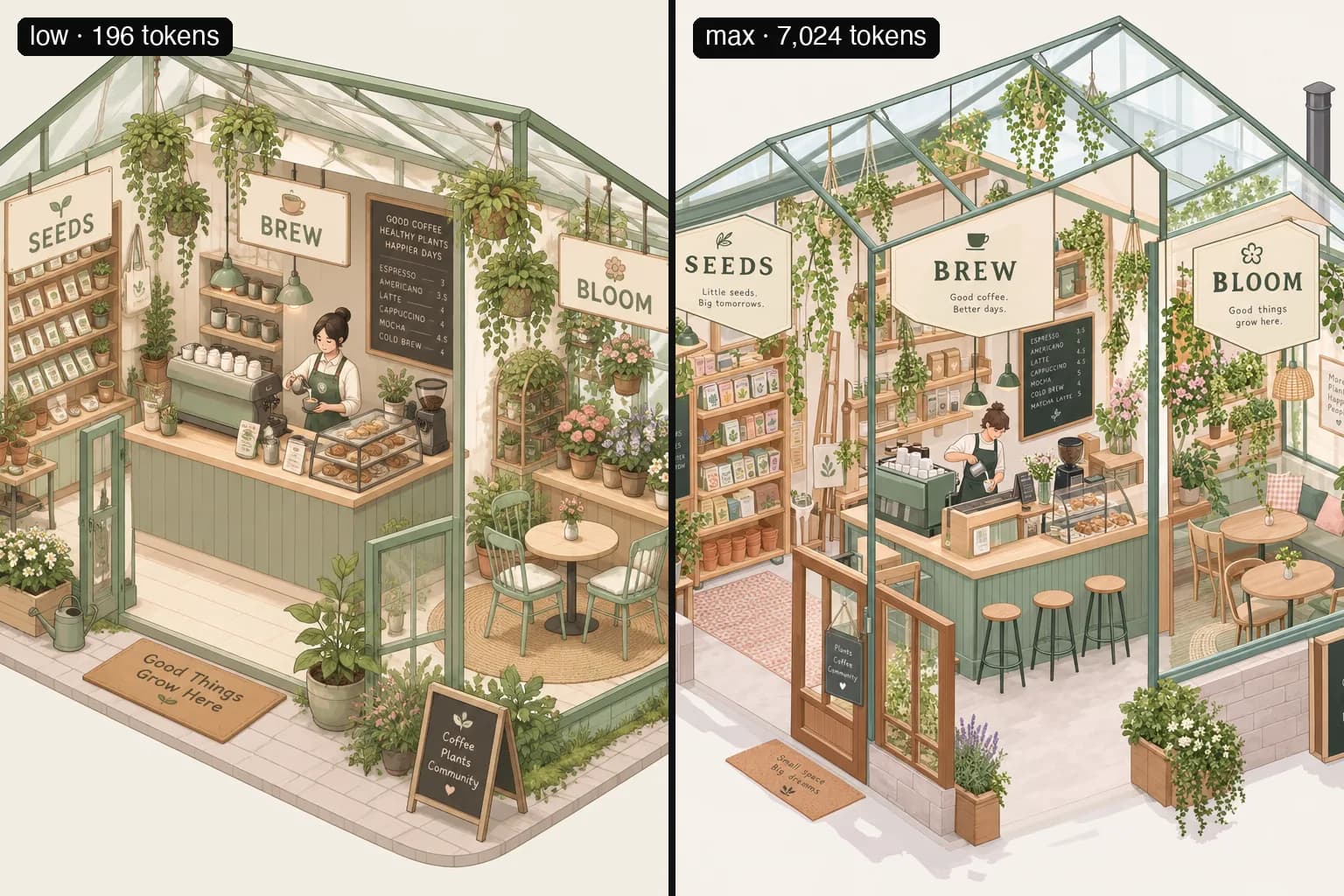
We sent one prompt, an isometric greenhouse café with three labelled zones, to both models at 1024×1024 on every quality level:
| Quality | Flare output tokens | Sunburst output tokens |
|---|---|---|
| low | 196 | 196 |
| medium | 439 | 439 |
| high | 1,756 | 1,756 |
| xhigh | 3,122 | 3,122 |
| max | 7,024 | no count (render failed) |
From low to xhigh the counts are identical; the Sunburst max render failed, so that row has no pair. Both models reported 50 text input tokens for the prompt. Identical tokens at identical rates means identical cost, so price should play no part in choosing between them. The per-quality cost is worked out in GPT Image 2.5 API pricing.
Where Sunburst was slower
Times are seconds from task creation to completion, as reported on the task. They include queueing in our pipeline, so read the gaps, not the absolute values.
On the -official IDs, same café prompt at 1024×1024:
| Quality | Flare | Sunburst |
|---|---|---|
| low | 43 | 47 |
| medium | 42 | 63 |
| high | 47 | 63 |
| xhigh | 59 | 81 |
| max | 83 | failed after 424 s |
Sunburst was behind at every level, by 16 to 22 seconds from medium up. The failed max render returned no image and the ledger shows nothing charged for it, which is how failed tasks are meant to work on TokLab.
On the per-image Standard IDs the picture was different. Across seven Flare/Sunburst pairs at high and max, Flare finished first three times and Sunburst four times; the largest gap went each way (cafe at high: 42 s against 59 s; poster at max: 64 s against 39 s). If Flare has a speed edge there, one run per setting was not enough to see it.
Four prompts, side by side
All of these are unedited outputs. Labels show the model and quality.
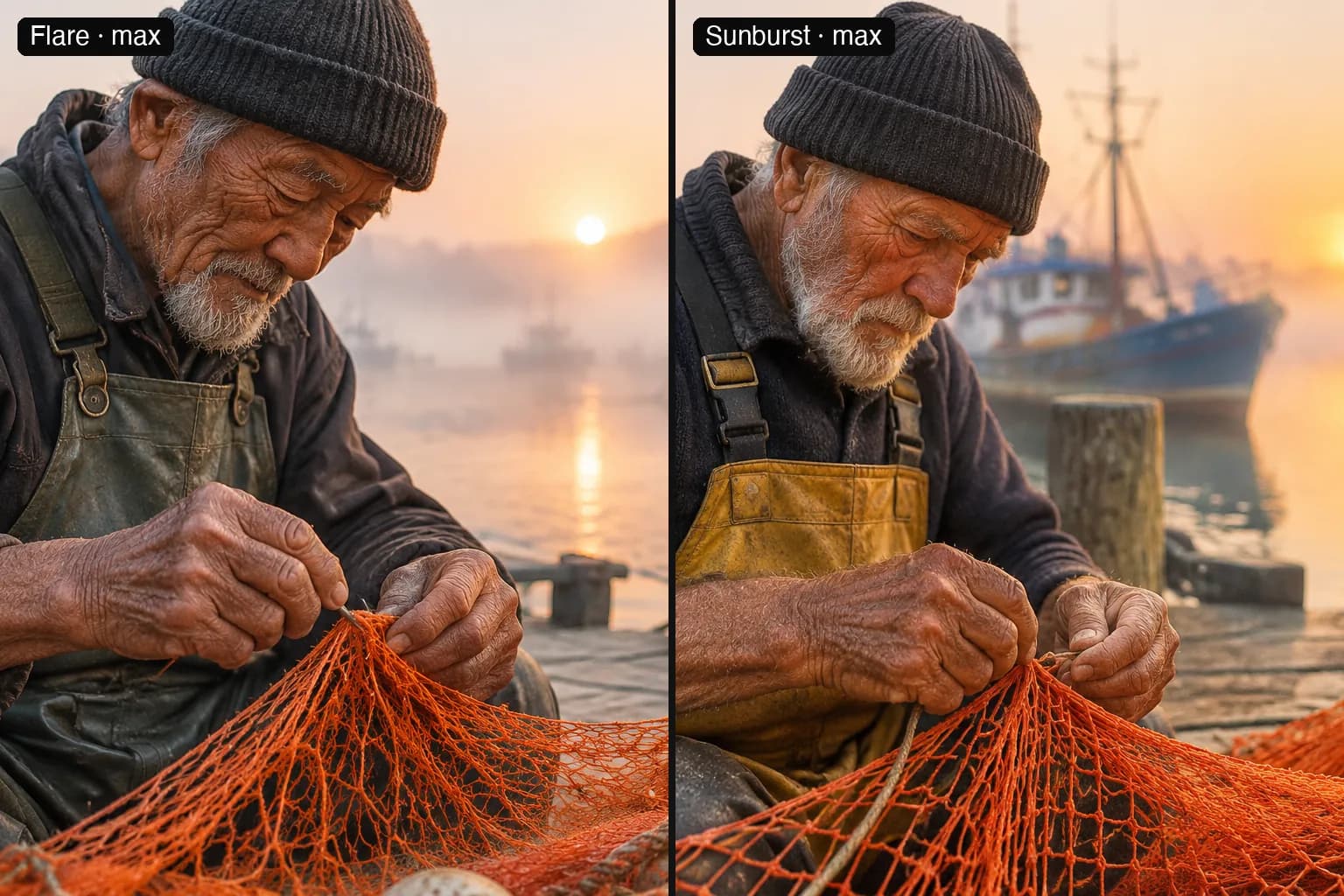
The fisherman prompt asked for dawn mist, an orange net and hands in sharp focus. Both got all three. They chose different men, different boats and different light: Flare's mist is thicker, Sunburst added a lighthouse and a stronger sun. Neither has the warped fingers that used to give these images away.
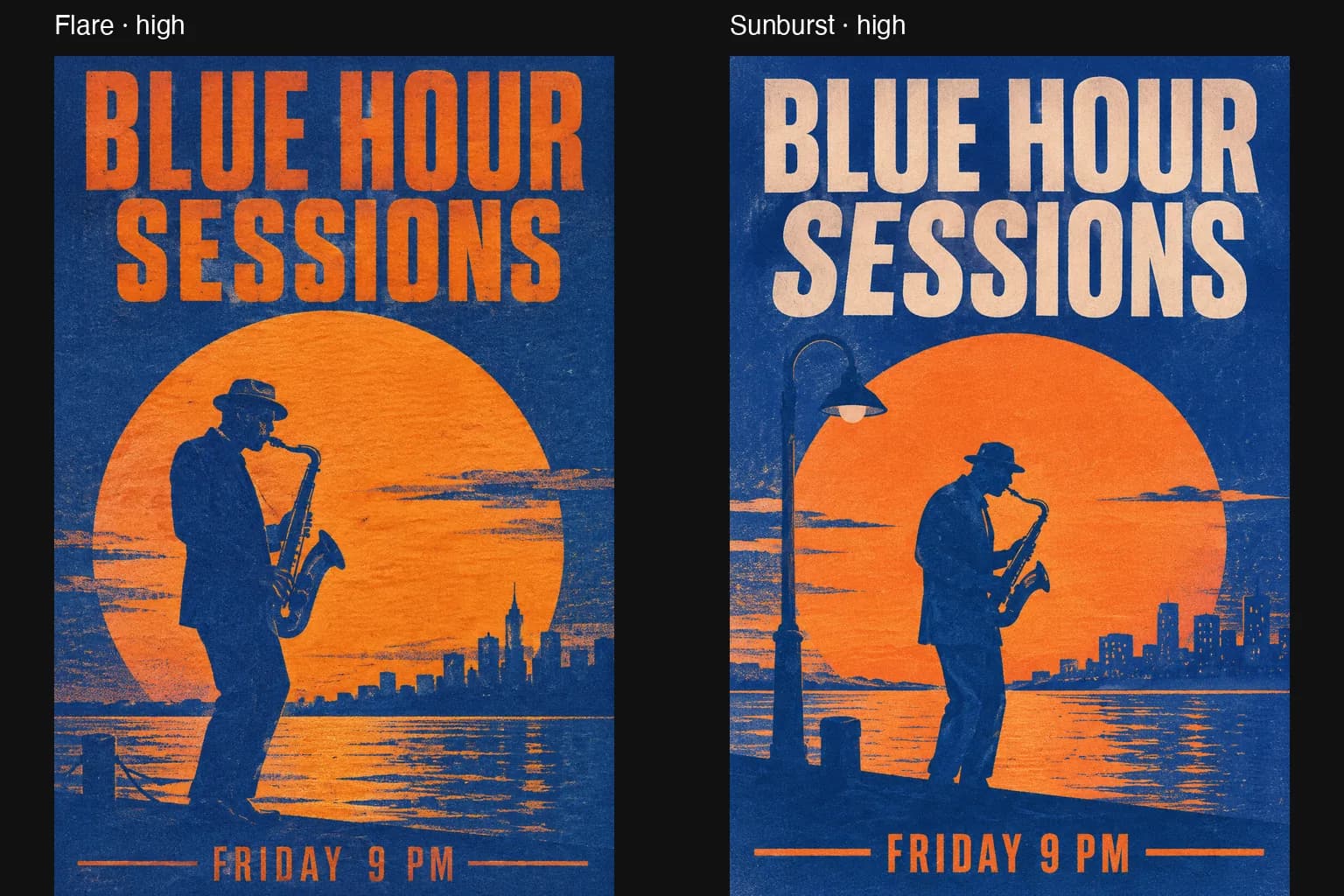
The poster is the text test. Both spelled BLUE HOUR SESSIONS and FRIDAY 9 PM correctly, kept to two inks, and set FRIDAY 9 PM in condensed type along the bottom as asked. Sunburst added a street lamp nobody asked for. That is a taste call, not an error.
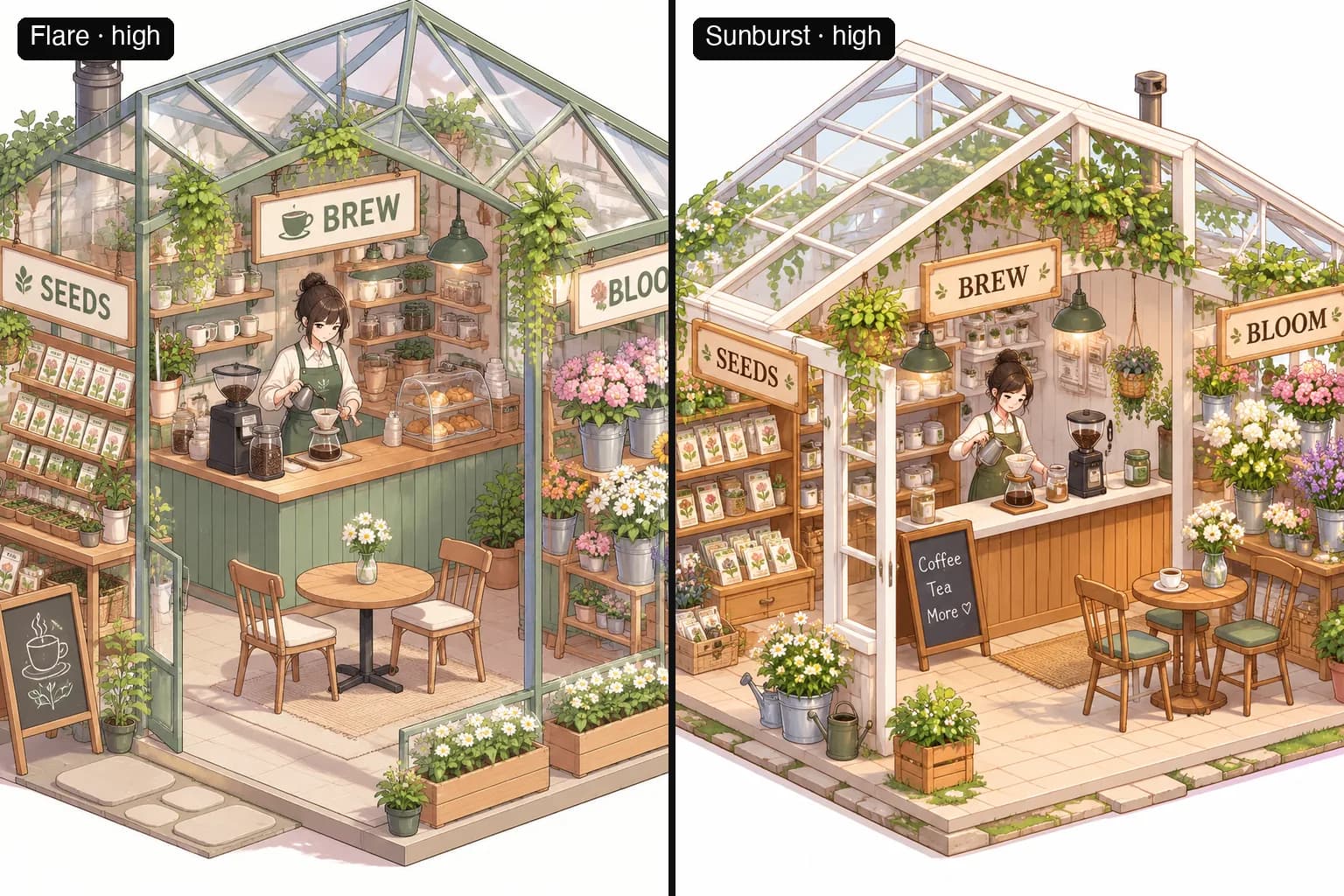
The three required labels came out right on both, and both invented extra signage and a readable drinks menu. Sunburst's building is more rigid and architectural, Flare's softer. Small invented text on either one deserves a proofread before it goes anywhere public.
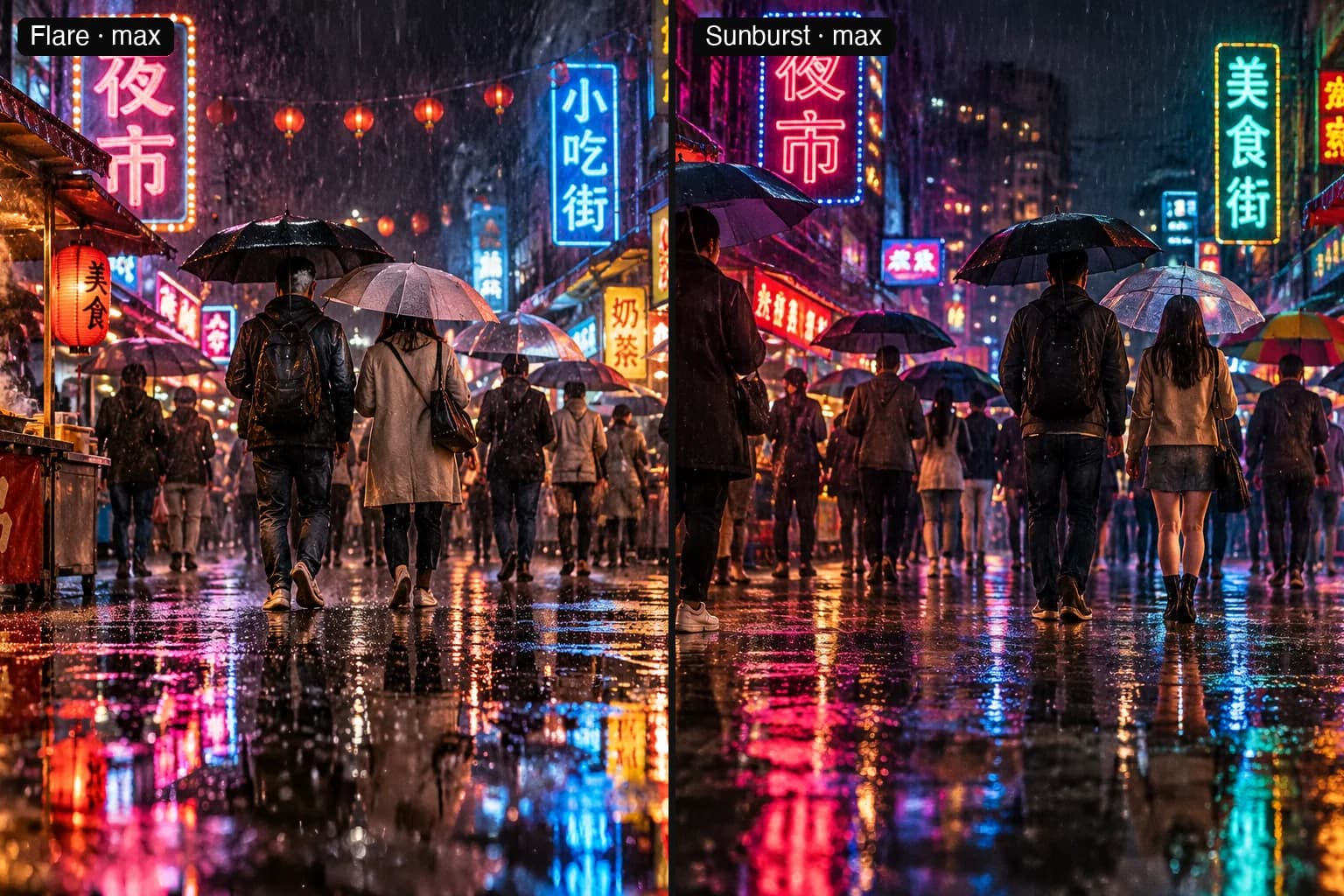
The night market prompt did not mention a language or a city. Both models went for Chinese signage on their own, and the characters we checked (夜市, 烤串, 臭豆腐 and the rest) are real words used correctly. Flare's reflections are busier; Sunburst's street is cleaner and more evenly lit.
What separated the two was style, not correctness. If one look suits your product better, that is a fine reason to pick a model, since it costs nothing extra.
What we did not test
The biggest gap is editing. OpenAI describes Sunburst as the model "for workflows where editing precision matters most" and Flare as its "fastest model for high-quality, everyday image generation" (model pages). We had planned a three-round edit test and cut it from this round, so we have no evidence of our own either way. If your product is mostly edits, run your own references through both before you commit.
Two smaller gaps: every token count is at 1024×1024, and larger canvases use more; and every timing is a single run.
How to tell which one ran
A question from a YouTube comment thread: "How we gonna know that we use sunburst or flare?" Over the API there is no guessing. You pick the model by ID, nothing swaps it for you, and the finished task reports the model it ran:
{ "id": "task_...", "model": "gpt-image-2.5-sunburst", "status": "completed" }Your usage history also lists the model against every task and its charge.
Which ID to put in your code
On TokLab each model has a Standard ID with a set price per image and an -official ID billed by tokens:
gpt-image-2.5-flareandgpt-image-2.5-sunburstgpt-image-2.5-flare-officialandgpt-image-2.5-sunburst-official
The request body is identical for all four, so switching is a one-word change. Our pick: start on gpt-image-2.5-flare, iterate at low quality, and move a job to Sunburst when you are editing and your own tests show it keeping more of the original. The GPT Image 2.5 playground runs both on your balance with the same fields as the API, and the API reference has the full parameter list.