Runware alternatives: when to stay and when to switch
Runware alternatives for closed image and video models, compared with Runware on open models and GPUs. Prices checked November 4, 2026, with a real bill.
Read as MarkdownIf you're looking for a Runware alternative, the first thing to know is that you may not need one for most of your traffic. Runware's low prices are real, but they are concentrated in one kind of model.
On open-weight image models such as FLUX, Runware charges a fraction of what other platforms do. On closed models such as Nano Banana Pro and GPT Image 2.5, it charges the list price or close to it. Whether you should switch depends on which of those two your bill is made of.
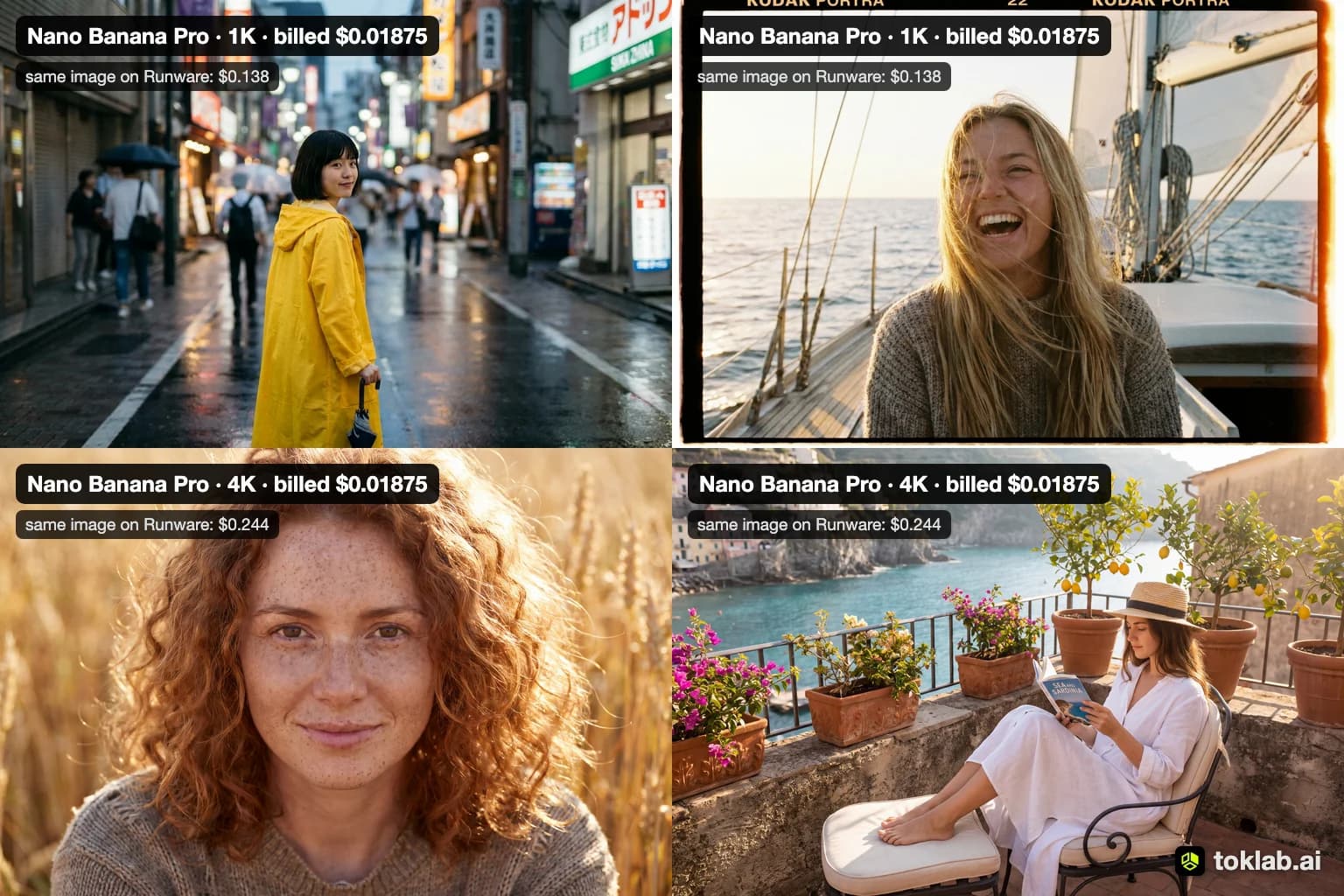
This guide splits Runware by workload, shows where it wins and where it doesn't, and ends with a table you can map your own models against. We'll use one real job throughout: four Nano Banana Pro images, two at 1K and two at 4K, which Runware lists at $0.764. We rendered them on TokLab on November 4, 2026 for $0.075.
TokLab is our product. Runware beats it on several rows below, and those rows stay in.
What is Runware?
Runware is an inference platform that sells hosted AI models through one API and rents serverless GPUs. Its pricing page describes a registry of 400K+ models, with published pay-as-you-go rates for 300+ of them.
Three things set its shape:
- One endpoint for every model: you send an array of tasks to
https://api.runware.ai/v1, each with ataskTypeand ataskUUID, over REST or a WebSocket atwss://ws-api.runware.ai/v1. - Results by webhook or connection: a
webhookURLon the task gets an HTTP POST when it completes; on a WebSocket, each response carries the request ID. - Billing per output, GPUs per second: images and clips have listed prices, and its pricing FAQ says you are "only charged for successful API requests that generate outputs." New accounts that sign up with a business email get $2 in credits.
Runware also publishes a savings page, runware.ai/alternative, with 85 models and an average saving of 40% against fal.ai, Replicate and WaveSpeedAI. Every one of the 85 rows shows Runware lower. Kling 4.0, which Runware prices at the same $0.157 a second as those three, is not in the table, and neither is GPT Image 2.5. The page is accurate for the models it lists; it doesn't tell you about the ones it leaves out.
Where Runware is the cheapest option
Runware is cheapest on open-weight models and on raw GPU time. The figures below come from its comparison page and pricing page, checked November 4, 2026.
| Open model, per image | Runware | fal.ai | Replicate | WaveSpeedAI |
|---|---|---|---|---|
| FLUX.2 [klein] 4B | $0.0006 | $0.005 | $0.001 | $0.008 |
| FLUX.1 [schnell] | $0.0013 | $0.003 | $0.003 | $0.003 |
| FLUX.1 [dev] | $0.0038 | $0.025 | $0.025 | $0.012 |
| Qwen-Image-Edit | $0.0032 | $0.03 | $0.03 | $0.02 |
| GPU, on demand, per hour | Runware | fal.ai | Replicate |
|---|---|---|---|
| L40S | $1.60 | — | $3.51 |
| H100 | $3.95 | $4.50 | $5.49 |
Runware also lists reserved H100 capacity on 2- to 4-year terms "as low as $2.45" a GPU-hour. The fal.ai, Replicate and WaveSpeedAI prices in the first table are the ones Runware publishes; we didn't check them on those platforms. TokLab doesn't sell these models. If FLUX or your own fine-tunes are most of your bill, stay on Runware.
Where Runware costs more
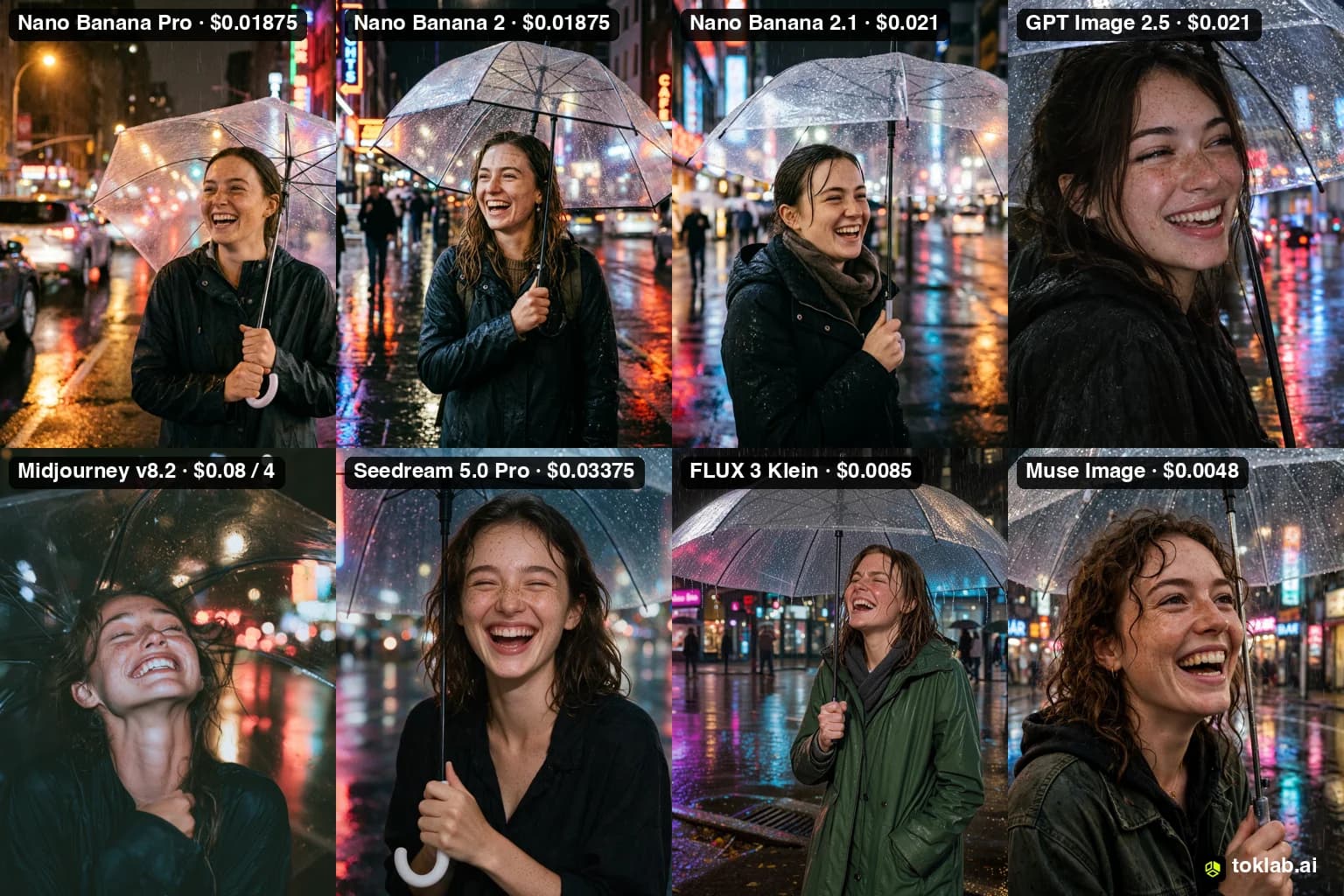
On closed models, Runware charges what the market charges, and some platforms charge much less.
Nano Banana Pro. Runware's model page lists $0.138 an image at 1K and 2K and $0.244 at 4K. Platforms that sell it on a flat-rate route charge far less, and the price barely moves with resolution:
| Platform | 1K | 4K |
|---|---|---|
| Runware | $0.138 | $0.244 |
| TokLab, flat-rate route | $0.01875 | $0.01875 |
| reapi.ai, default route | $0.028 | $0.030 |
| kie.ai | $0.09 | $0.12 |
| fal.ai | $0.15 | $0.30 |
GPT Image 2.5. Runware bills GPT Image 2.5 Flare by token at OpenAI's own rates: $5 per million text input tokens, $8 per million image input tokens and $30 per million image output tokens. Applied to the token counts of a 1024×1024 Flare image from our GPT Image 2.5 API pricing test, that's $0.0061 at low quality, $0.0529 at high and $0.2110 at max. TokLab's flat-rate route charges $0.021, $0.021 and $0.0225. At low quality Runware is cheaper; at max it costs about nine times as much.
Video. Runware lists Kling 4.0 at $0.157 a second at 720p, the same as fal.ai and Replicate; TokLab's Kling 4.0 is $0.1425. For Seedance 2.5 at 480p and 720p, Runware bills ByteDance's own token rate of $10.7 per million tokens, so moving that traffic saves almost nothing. Our cheapest Seedance 2.5 API comparison has the full table, including TokLab's Seedance 2.5.
What four Nano Banana Pro images cost
We rendered the four images at the top of this page on November 4, 2026 with Nano Banana Pro on TokLab's flat-rate route, all 3:2.
| Image size | Output | TokLab, billed | Runware, list |
|---|---|---|---|
| 1K | 1264×848 | $0.01875 | $0.138 |
| 1K | 1264×848 | $0.01875 | $0.138 |
| 4K | 5056×3392 | $0.01875 | $0.244 |
| 4K | 5056×3392 | $0.01875 | $0.244 |
| Total | $0.075 | $0.764 |
Source: TokLab account balance before and after each image, November 4, 2026; Runware model page, same day.
Three things stand out:
- Resolution didn't change the price: the 4K files came back at the full 5056×3392 and cost the same as the 1K ones.
- The gap grows at 4K: Runware's 4K price is 13 times the flat-rate one, against 7 times at 1K.
- Volume makes it large: at a thousand 4K images a month, the difference is $225.25.
Which workload goes where
| If most of your Runware bill is… | Do this |
|---|---|
| FLUX, Qwen-Image or other open models | Stay on Runware. Nothing in this guide is cheaper. |
| Your own models or LoRAs | Stay, or compare Runware's GPU prices with fal.ai's. |
| Nano Banana Pro | Move it to a flat-rate route (TokLab, reapi.ai). |
| GPT Image 2.5 at high or max quality | Move it to a flat-rate route. Keep low quality on Runware. |
| Kling 4.0 | Move it if 9% matters; TokLab is $0.1425 a second at 720p. |
| Seedance 2.5 at 480p or 720p | Leave it. Runware already bills ByteDance's rate. |
How to move part of a workload off Runware
- Total a month of usage by model. Group your own request logs by model and sort by cost.
- Price the top three models elsewhere. Use your real sizes and quality settings. The answer for 1K images is different from 4K.
- Map the request. Runware takes an array of tasks with
positivePromptand size fields. TokLab takes the model's own request body on/v1/images/generationsor/v1/videos/generations. - Replace the result channel. If you rely on Runware's WebSocket or
webhookURL, plan for polling: on TokLab you callGET /v1/tasks/{id}until the task completes. - Keep both keys. Route open models to Runware and closed models elsewhere from the same code path.
FAQ
Is Runware cheaper than fal.ai?
On open models and GPUs, yes, often by 50% to 90%. On closed models it is about the same: both charge $0.157 a second for Kling 4.0, Runware is $0.012 cheaper on Nano Banana Pro at 1K, and both are near OpenAI's token price on GPT Image 2.5.
Does Runware have a free tier?
New users who sign up with a business email get $2 in free credits, according to its pricing page. After that it is pay as you go, with volume pricing on request.
Does Runware charge for failed requests?
Its pricing FAQ says you are only charged for successful requests that generate outputs, and that rate-limited requests are not billed.
What is the cheapest Runware alternative for Nano Banana Pro?
Of the platforms here, TokLab's flat-rate route at $0.01875 an image at any size, then reapi.ai's default route at $0.028 to $0.030.
Start with your most expensive closed model
You don't have to leave Runware to cut the bill. Find the closed model that costs you the most there, render one real job on a flat-rate route, and compare the charge. If it's Nano Banana Pro at 4K, the first image will show the difference. Current TokLab rates are on the pricing page.