The best AI image generators in 2026: 8 models, the same 4 prompts
Eight AI image generators got the same four prompts: a portrait, a group, a chalkboard sign and a product shot. What each drew, its price, where it is free.
Read as MarkdownIf you make images with AI, you're probably doing it inside an app: ChatGPT, Gemini, Meta AI or Midjourney. The app decides how you type the prompt. The model behind it decides what the picture looks like, and for realistic images there are about eight models worth knowing right now.
So instead of ranking apps, we ranked the models. On November 4, 2026 each of the eight got the same four prompts: a candid portrait in the rain, five friends passing food around a table, a chalkboard sign with exact wording, and a product shot of a mug. That's 32 paid requests, $0.8261 in total, with the first result kept every time.
We make TokLab, and the test ran through its API, which sells all eight models. Where you can use the same model for free in an app, we say so, because for a few images a day that's the better deal.
What to use: the quick answers
If you want one model for everything, use Nano Banana Pro or Nano Banana 2.1. Neither won a single round outright, but both got the sign text right, drew believable groups and never added anything strange to the product shot.
If you want the most realistic AI image generator for portraits, use GPT Image 2.5 or Seedream 5.0 Pro. Both drew skin and freckles that look photographed rather than painted.
If you pay per image and make a lot of them, use Muse Image. At $0.0048 it costs about a quarter of most of the others, and its portraits held up.
If you want a mood more than a photo, Midjourney is still the one with a look of its own. It has no free plan at all.
What each one costs
| Model | Free in an app | Paid app plan | API price | Arena Elo |
|---|---|---|---|---|
| GPT Image 2.5 | ChatGPT Free (limited) | ChatGPT Go $8, Plus $20, Pro $100 a month | $0.021 (high) | 1207 (max) |
| Nano Banana 2.1 | no | a Google AI plan | $0.021 | 1176 |
| Nano Banana 2 | Gemini | a Google AI plan for higher limits | $0.01875 | 1140 |
| Muse Image | Meta AI | none listed | $0.0048 | 1127 |
| Nano Banana Pro | no | a Google AI plan ("Redo with Pro") | $0.01875 | 1118 |
| Seedream 5.0 Pro | Dreamina's free tier | Dreamina plans | $0.03375 | 1101 |
| FLUX 3 Image Klein | BFL playground, open weights | none needed | $0.008472 | 1043 |
| Midjourney v8.2 | no | from $10 a month | $0.08 per job of 4 images | not listed |
Source: ChatGPT, Gemini and Midjourney plan pages, November 4, 2026. API prices are what TokLab billed us per image that day, or per job for Midjourney. Elo is the Artificial Analysis Image Arena text-to-image score the same day; it rates GPT Image 2.5 at max quality, and we used high.
The four prompts
Each prompt stands for a job people actually use image generators for:
| Job | Prompt |
|---|---|
| Realistic portrait | "Candid photo of a young woman with freckles laughing in the rain under a clear umbrella on a city street at night, neon reflections on wet pavement, natural skin texture, 50mm lens" |
| People and hands | "Documentary photo of five friends of different ages laughing around a kitchen table, passing plates of food to each other, everyone's hands clearly visible, warm evening light" |
| Text in an image | "Photo of a hand-painted chalkboard sign on a sidewalk outside a cafe that reads exactly: TODAY: OAT MILK FLAT WHITE $4.50, morning light" |
| Product photo | "Product photo of a matte sage-green ceramic coffee mug on a walnut table, soft window light from the left, shallow depth of field, no text, no logo" |
Every image was square at about 1K and each model ran at its default settings, except GPT Image 2.5, which we set to high quality. One Midjourney request failed without a charge and was resubmitted. Below, each model gets its own section with its four results.
GPT Image 2.5: the most photographic close-ups, and a habit of adding words
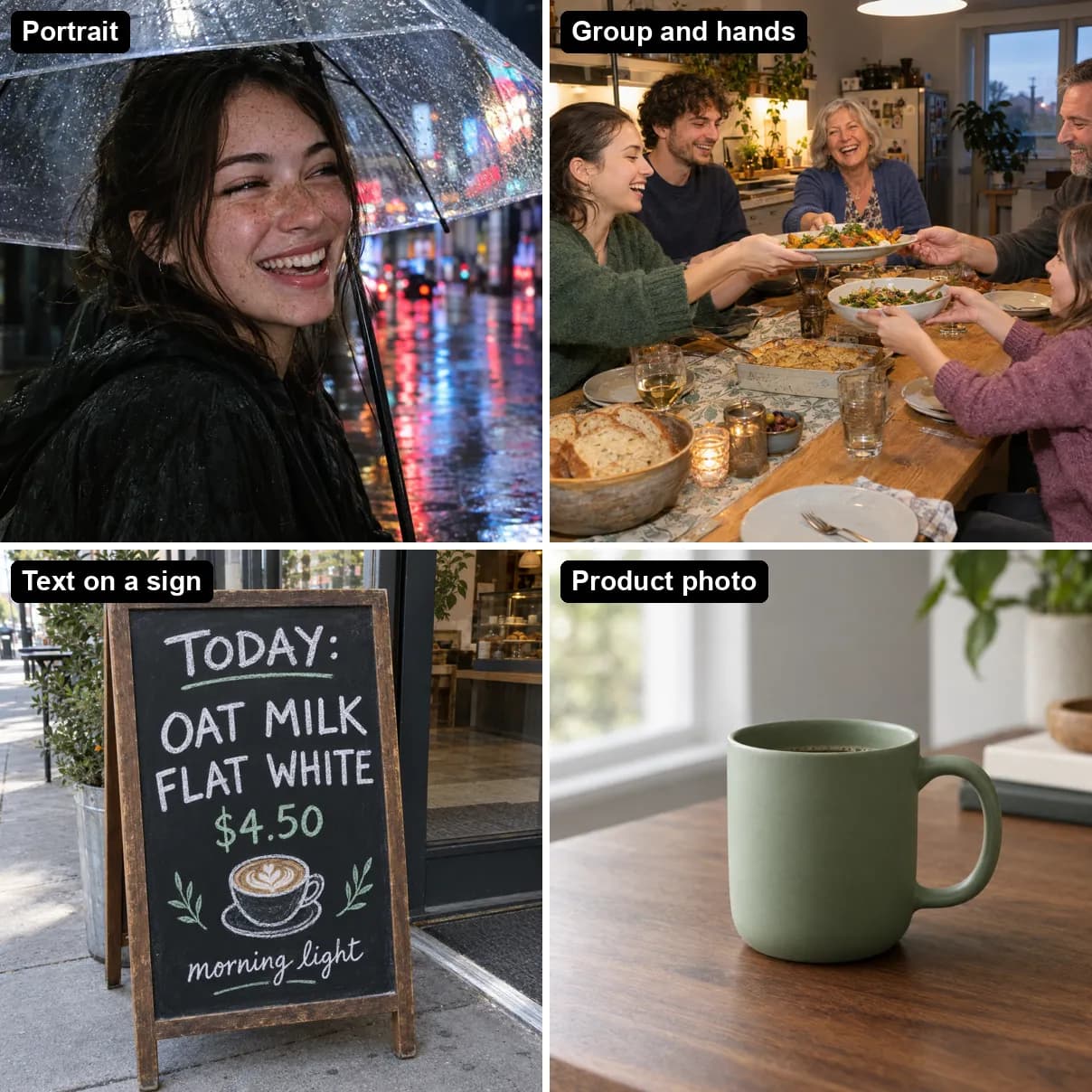
This is the model behind ChatGPT's image generation. OpenAI calls it ChatGPT Images 2.5 in the app and rolled it out to free and paid users in September 2026, and it tops the Artificial Analysis Image Arena at 1207 for its max setting.
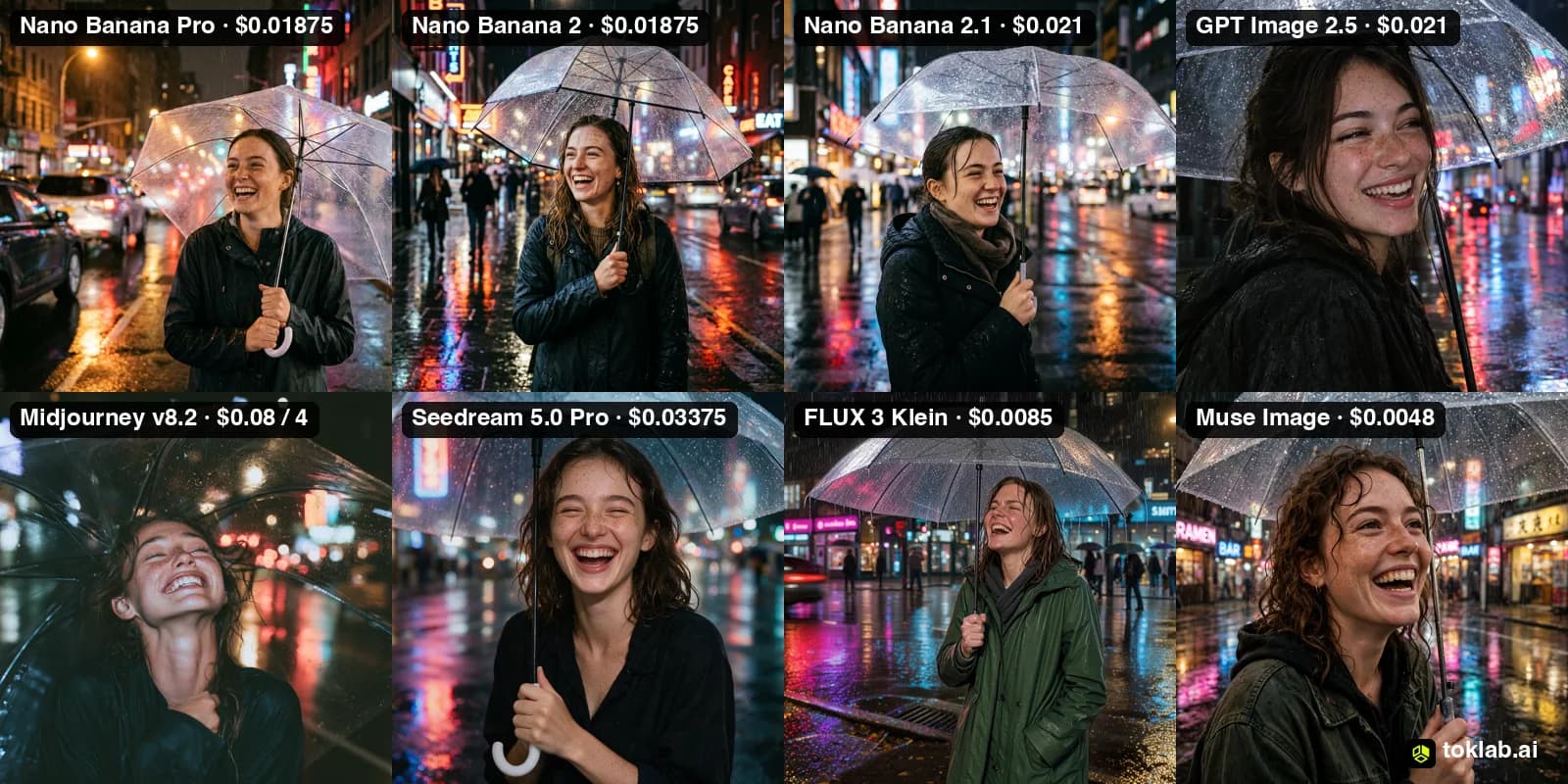
Its portrait was the one we'd most likely mistake for a photo. It framed her face up close, with raindrops on the umbrella and freckles across her nose and cheeks. Its group scene has candles, bread and a warm kitchen glow, and the mug sits on the walnut with a plant blurred behind it.
It went its own way on the chalkboard. The words are spelled right, but it also drew a latte with a heart in the foam and wrote "morning light" across the bottom. It read the lighting instruction as text to paint. If your prompt mixes words for the image with words for the picture, check what lands on the sign.
Where to use it: ChatGPT's free plan includes "Limited image creation"; Go at $8 a month adds more. Through the GPT Image 2.5 API, $0.021 an image at high quality.
Nano Banana 2.1: the safest choice for text and busy scenes
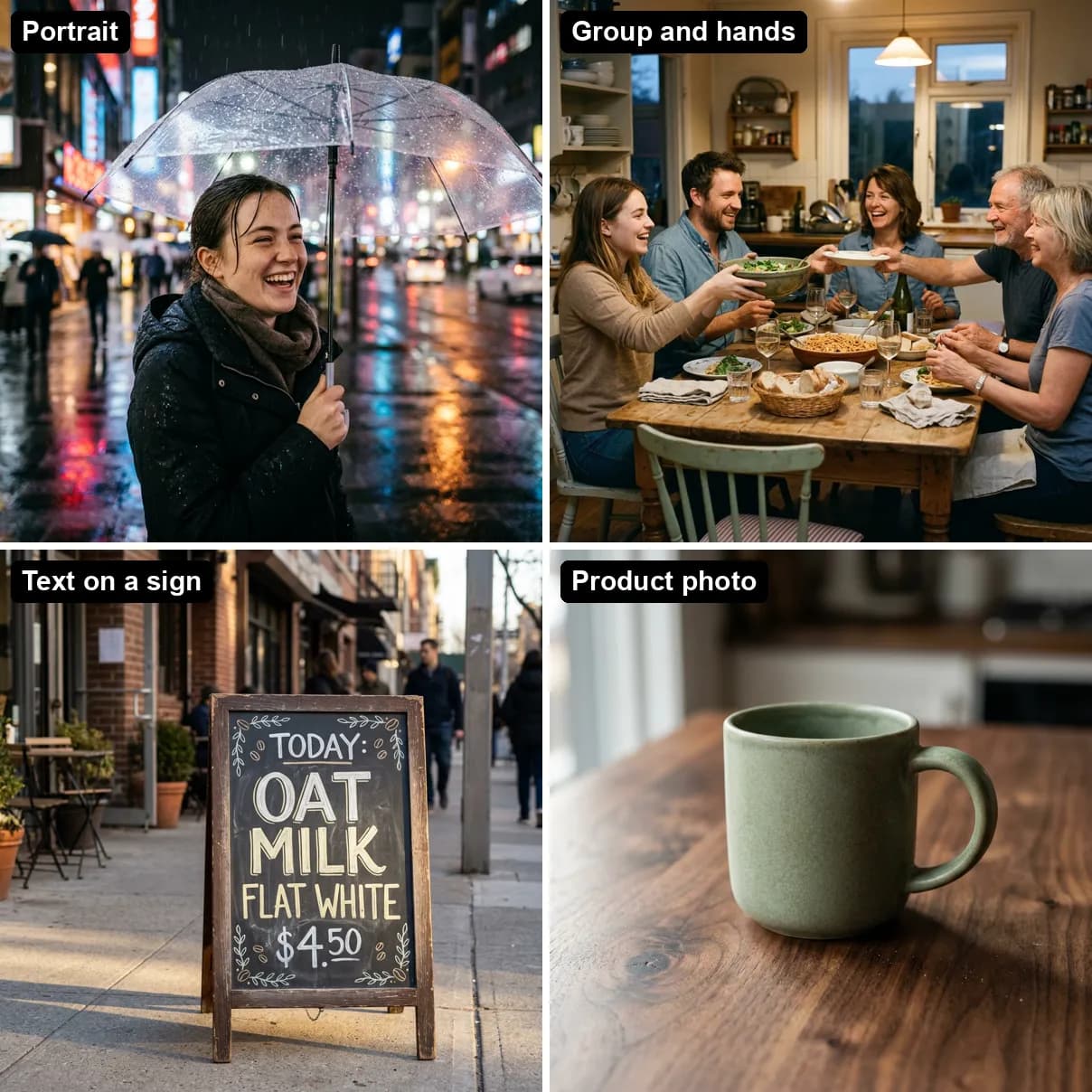
Nano Banana 2.1 is Google's newest image model and the second-highest on the leaderboard here, at 1176.
It got every word and the price on the chalkboard right, in big hand-painted letters that fill the board. Its group scene is the widest of the eight: a long table, a pendant lamp, people leaning across with dishes. The portrait shows her from the waist up with the whole street behind her, which looks right as a scene, but her face is too small to show freckles. Ask for a close-up if the face is the point.
Its mug is plain and matte, which is what the prompt asked for and not something every model managed.
Where to use it: in Gemini with a Google AI plan (Plus, Pro or Ultra). Through an API, $0.021 an image.
Nano Banana 2: free in Gemini, with one misplaced dollar sign
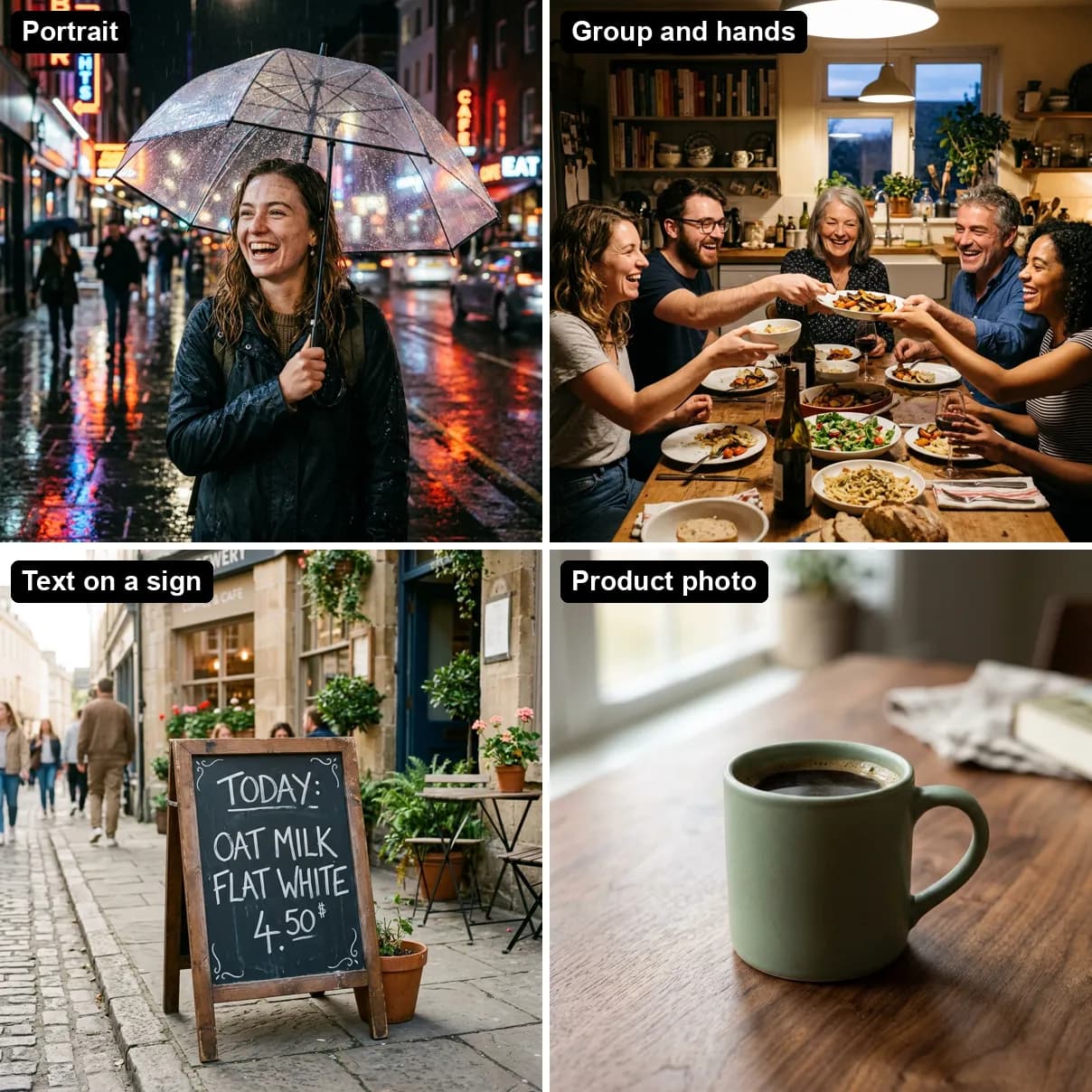
Nano Banana 2 is the model you get in Gemini without paying. Google's image page lists it as free.
It made the same kind of wide, full-scene portrait as the other Nano Banana models, and a busy, convincing group shot. Then it made the test's most specific mistake: the sign reads "4.50$", with the dollar sign after the number. On a real menu board that's the kind of error a customer notices. It also filled the mug with coffee, which the prompt didn't ask for.
For free everyday use those are small costs. For anything with prices or product copy on it, run the exact text first.
Where to use it: free in Gemini. Through an API, $0.01875 an image.
Muse Image: realistic portraits for under half a cent
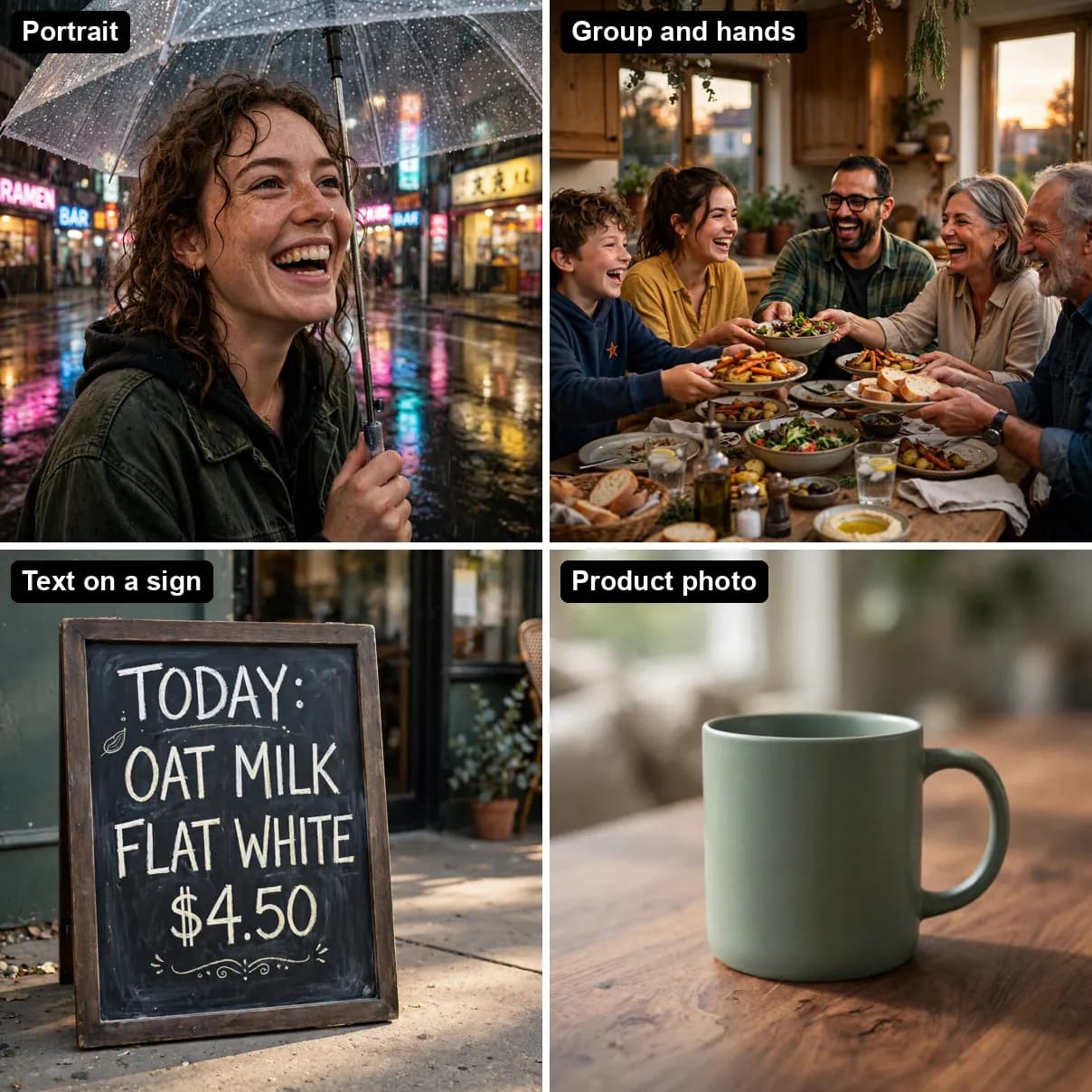
Muse Image is Meta's model, the one that creates and edits images inside Meta AI.
At $0.0048 an image it was by far the cheapest, and it didn't look cheap. Its portrait is a tight, laughing close-up with wet hair, one of the three most photographic of the eight. A child sits at its lively dinner table, and the sign is spelled exactly. Even the mug kept its matte glaze and the walnut grain.
Its scenes are a little generic. The street and the kitchen look like the average of every rainy street and kitchen, without the specific details some other models added. For catalog images or social posts at volume, that matters less than the price.
Where to use it: inside Meta's apps, where Meta lists no price. Through an API, $0.0048 an image.
Nano Banana Pro: reliable on everything, best on nothing in particular
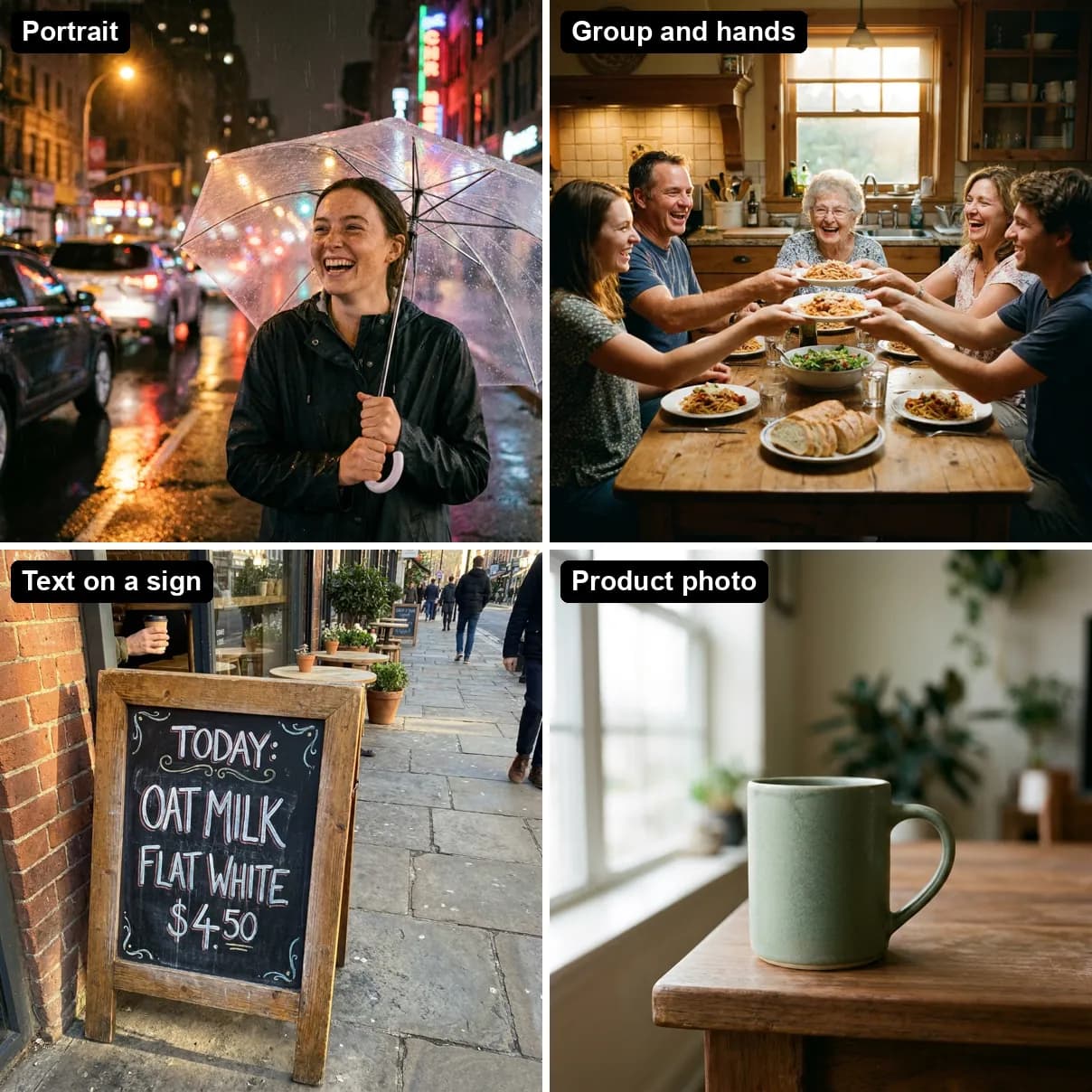
Nano Banana Pro scores lower on the leaderboard than the two newer Nano Bananas, at 1118, and in our four prompts it behaved like a careful professional. No round went wrong.
It spelled the sign correctly and set it on a brick sidewalk, and it left the mug empty and matte beside a window. Its group scene is brighter than "warm evening light" suggests, closer to late afternoon, but everyone is passing food and smiling. As with the other Nano Banana models, the portrait is a wide shot where the woman is small in the frame.
If you need one model to run unattended across many kinds of prompts, this is the kind of result you want: nothing to fix.
Where to use it: in Gemini on a paid plan, through "Redo with Pro". Through an API, $0.01875 an image.
Seedream 5.0 Pro: the most expressive people
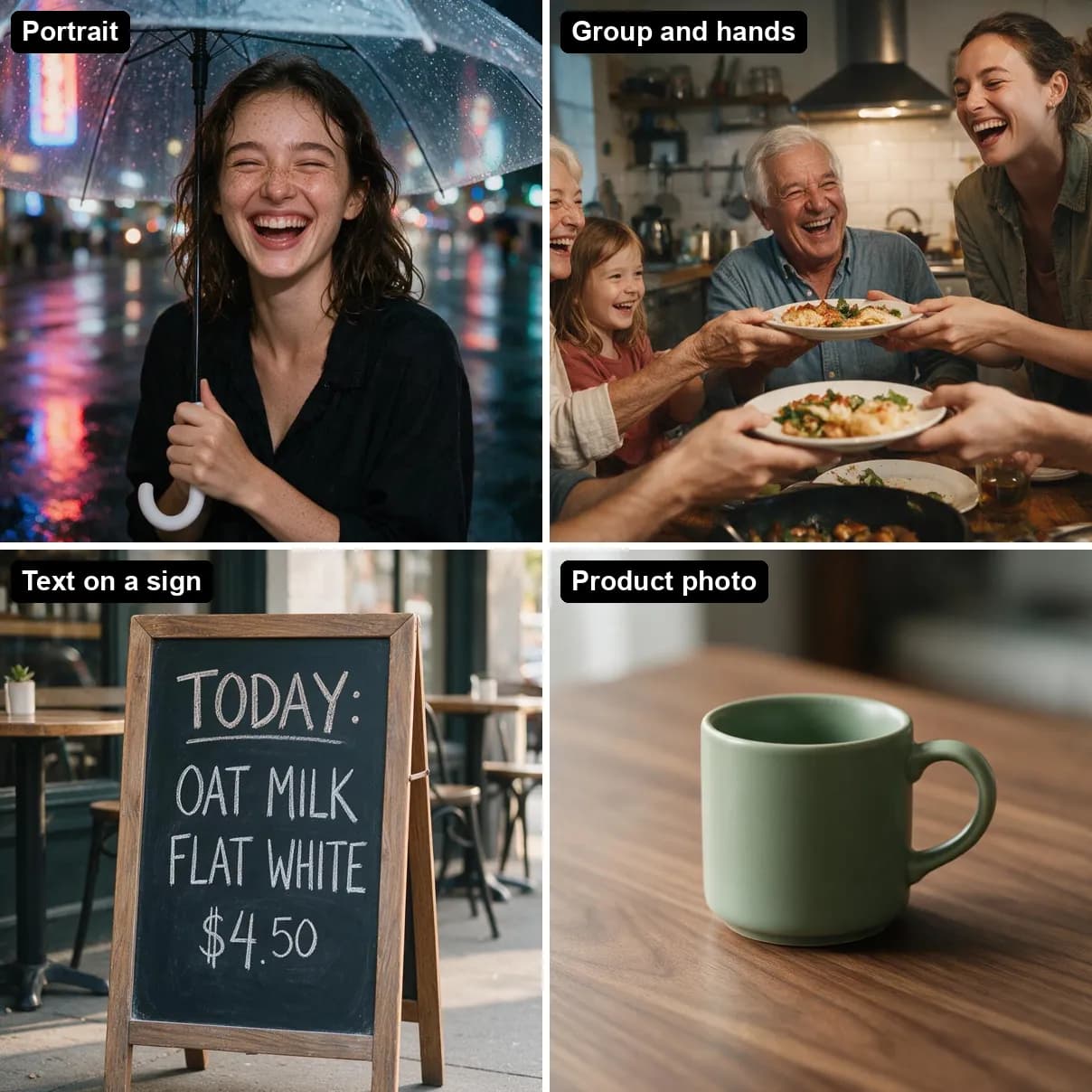
Seedream 5.0 Pro is ByteDance's model, the one behind its Dreamina app.
It cropped tighter than anyone else on the group prompt. The frame is built around an older man laughing as he passes a plate, with a girl and a woman beside him, and it reads like a moment someone caught rather than a staged dinner. Its portrait is a close-up in a black shirt with neon behind her, as photographic as GPT Image 2.5's. Its chalkboard has the cleanest, most legible lettering of the eight.
It was also the most expensive model per image, at $0.03375, a little over seven times the price of Muse Image.
Where to use it: Dreamina, which calls itself a free AI image generator. Through an API, $0.03375 an image.
FLUX 3 Image Klein: good drafts for under a cent
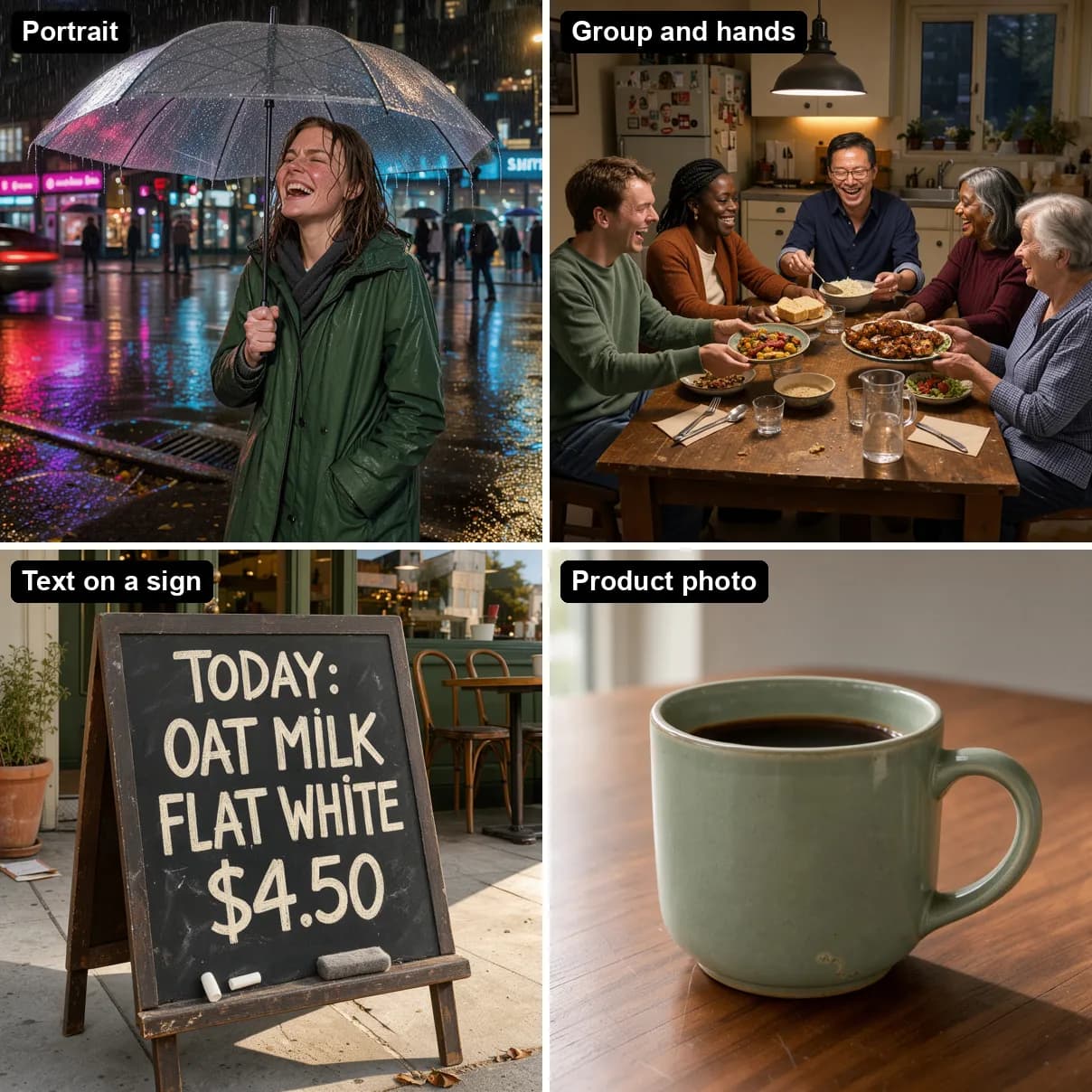
FLUX 3 Image Klein is Black Forest Labs' small model, and the only one here with open weights you can run yourself.
At $0.008472 an image it's the second-cheapest, and its results are usable across the board. Its sign is spelled right, with a few sticks of chalk on the ledge, a nice detail nobody asked for. Everyone at its table is clearly lit and passing food, and its portrait put her in a green raincoat with the whole street around her.
Its lighting is flatter than in the top models, and like Nano Banana 2 it filled the mug with coffee. For working out a composition before paying for a final image, those are fine trade-offs.
Where to use it: Black Forest Labs' browser playground, or on your own GPU with the open weights. Through an API, $0.008472 an image.
Midjourney v8.2: a look of its own, and loose with physics
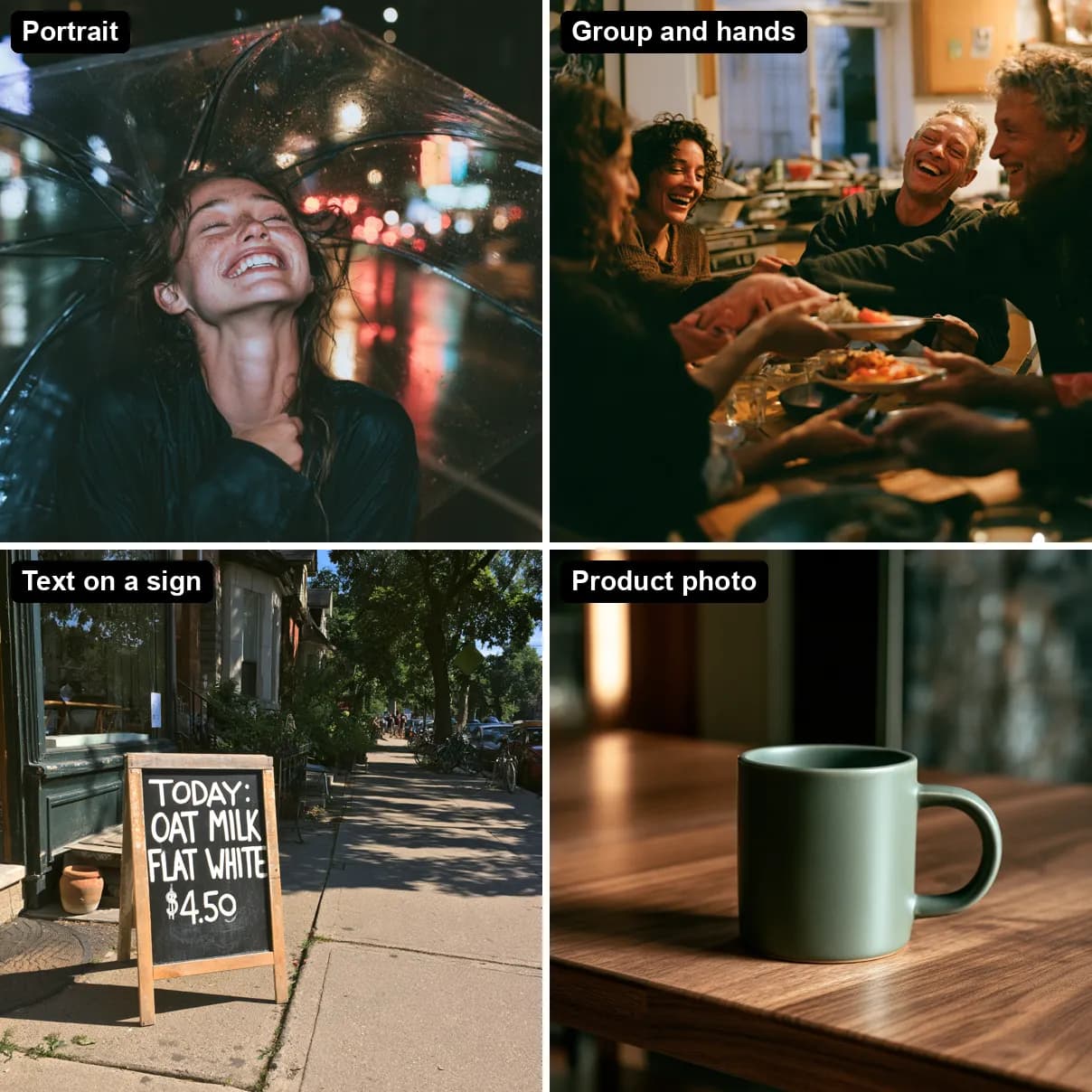
Midjourney made the most cinematic pictures. The portrait shows her head tilted back, laughing, under a glowing umbrella. The dinner is dim and amber, with hands blurring as plates move. If you like that look, nothing else here produces it by default.
The same looseness causes problems. In the portrait the umbrella floats over her with no hand holding it. In the group scene the hands at the front dissolve into motion, which is the opposite of "everyone's hands clearly visible". The product shot is darker than "soft window light". The sign is spelled exactly, though small in a sunny street scene.
It isn't on the Artificial Analysis leaderboard, so there's no independent score to compare. Each job returns four images; we kept the first.
Where to use it: only on a paid plan, from $10 a month for about 200 minutes of fast generation. Through the API, Midjourney cost $0.08 a job.
Is ChatGPT the best AI for image generation?
For close-up realism, ChatGPT is near the top: it runs GPT Image 2.5, the highest-rated model on the Image Arena, and its portrait was the most photographic in our test. It was also the only model to paint part of the prompt onto the image as words. For signs, menus and anything with exact text, Nano Banana Pro and Nano Banana 2.1 were more reliable, and for cheap portraits at volume Muse Image costs a quarter as much.
Which AI image generator is free?
Gemini (Nano Banana 2), ChatGPT (limited, GPT Image 2.5), Meta AI (Muse Image) and Dreamina (Seedream) all have free options, and FLUX 3 Image Klein is free to run yourself. Three of the eight need a paid plan in their app: Nano Banana 2.1 and Nano Banana Pro through a Google AI plan, and Midjourney, which has no free plan.
Other AI image generators we didn't test
Several apps on other best-of lists aren't separate models but places to use them, and some run several of the models above. We didn't test these; the details are from their pricing pages on November 4, 2026.
- Adobe Firefly: Adobe's models plus partner models from Google, OpenAI and Flux. From US$9.99 a month after a free trial.
- Ideogram: strong on typography. Plus is $20 a month; there's also pay-as-you-go at 1¢ a credit, and no free plan on its pricing page.
- Leonardo.Ai: free with 150 fast tokens a day and public creations; $12 a month for 80+ models and privacy.
- Canva: image generation inside a design tool. The free plan has limited AI; Pro costs US$144 a year.
What every model got right, and where they split
Every model mixed ages around the table and passed plates from hand to hand. Every one produced a usable product shot of the mug, which says more about how far image models have come than about any one of them.
They split on the sign. Six of the eight rendered "TODAY: OAT MILK FLAT WHITE $4.50" exactly; Nano Banana 2 wrote "4.50$" and GPT Image 2.5 added "morning light".
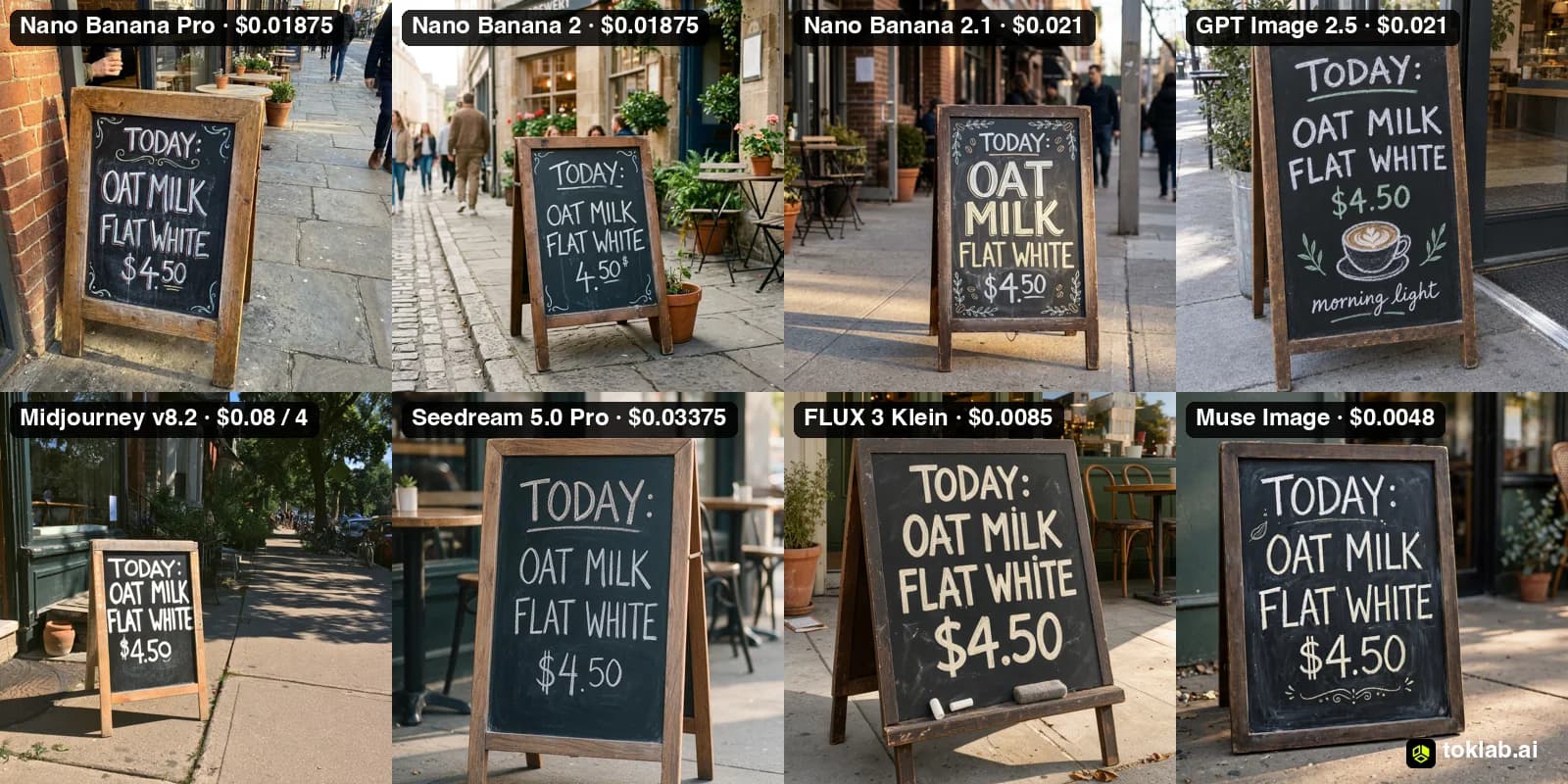
They also split on framing, more than on quality. The three Nano Banana models and FLUX 3 Image Klein drew the portrait as a street scene; GPT Image 2.5, Seedream 5.0 Pro and Muse Image went in close. Neither is wrong. It's a reason to say "close-up" or "wide shot" in your prompt instead of leaving it to the model.
What this test doesn't tell you
Each model ran each prompt once, and we kept the first image. A second run can come out differently, better or worse, so treat a single miss as a warning rather than a verdict. All images were square and at each model's default settings, apart from GPT Image 2.5's high quality; a model can do better with a tuned prompt, a different size or a higher quality tier.
The leaderboard is a better guide to average quality across thousands of prompts. Our four prompts are a better guide to specific failures, like a misplaced dollar sign or an umbrella nobody is holding. Use both, then run the one prompt you care about most on two or three of these models before you pay for a plan.